
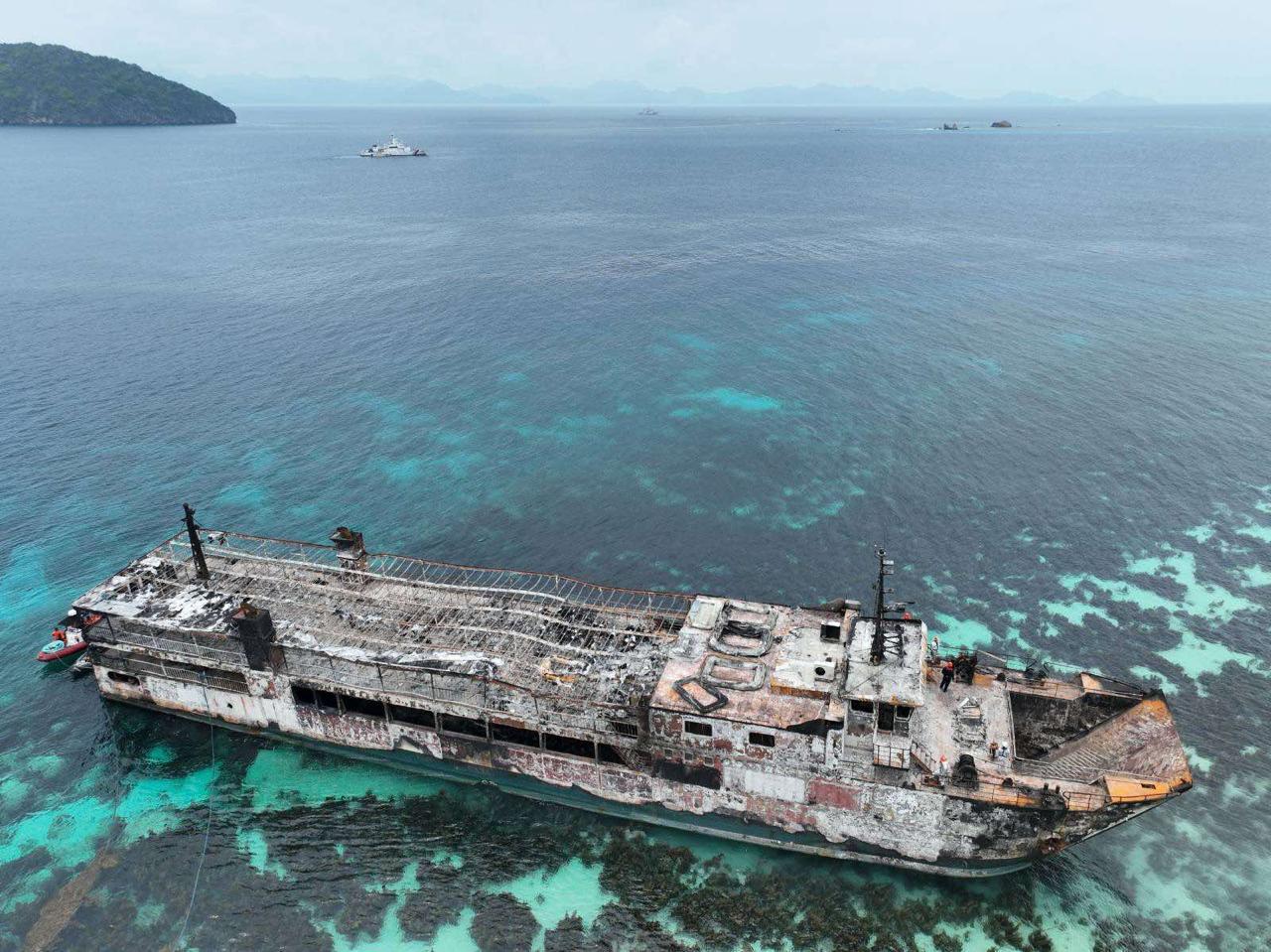
At least 76 people died when a passenger ferry caught fire in the Philippines, marking one of the most fatal maritime incidents this year. Before this, major ferry disasters also occurred in Zimbabwe and Guyana, including a capsize on Lake Kariba that killed at least 94 people, and the sinking of the MV Barima off Guyana’s coast with an estimated 100 fatalities. Newsweek reached out to the Philippine Coast Guard and Maritime Industry Authority for comment via email on Saturday.
Philippine Ferry Fire
The MV June Aster was carrying 132 people when it ignited Wednesday night, nearing the end of its 20-hour journey from Manila to Coron in Palawan province. The fire started about 24 miles from its destination, with survivors reporting they heard an explosion before smoke and flames engulfed the vessel. Investigators have not yet determined the cause, and a maritime safety and criminal investigation is set to begin. Over the past few days, authorities have been working to recover remains from the burned vessel, with forensic teams identifying victims.
Philippine Coast Guard official Geronimo Tuvilla stated at a press conference on Saturday that identifying victims and determining the fire’s cause are the immediate priorities. As of Saturday, there are 43 recorded survivors. The captain is reportedly alive, despite not being listed among them.
Ferry travel is crucial in the Philippines, an archipelago comprising over 7,600 islands, where many communities can only be reached by sea.
Zimbabwe Ferry Capsized
In August, a government-owned ferry carrying around 180 passengers capsized on Zimbabwe’s Lake Kariba, killing at least 94 people. State media described this as the deadliest transportation disaster in the country.
“When the boat capsized, most of the people scrambled to get the life jackets but most of them did not even know how to use them,” survivor Chance Siyamavhu told AFP. “Our relatives were swept in another direction and they sank because we were not in a position to help them.”
The vessel was traveling from Kariba to a remote lakeside community when it flipped due to strong waves. According to officials, the ferry was carrying roughly twice its capacity, which was 90 passengers.
Guyana Ferry Capsized
In July, the MV Barima, an 87-year-old state-run ferry, capsized off the coast of Guyana, leaving an estimated 100 dead after more bodies were found in the wreck. At least 69 people were rescued.
Authorities reported that the ferry overturned with 179 people on board during its journey from Georgetown to Port Kaituma. This disaster raised questions about the vessel’s passenger list and whether the crew’s actions contributed to the sinking.
Helena Moonsammy, a survivor who lost four grandchildren, told the Associated Press: “I was fighting for my life. The boat sunk in minutes, seconds.”
Indonesian Ferry Fire
At least five people died, and dozens went missing when the Mutiara Sentosa 2 ferry burned off Indonesia in August, carrying 271 passengers and 181 vehicles. The fire started before dawn during its journey from Surabaya to Makassar.
The large rescue operation managed to save about 230 passengers. Ferries are crucial in Indonesia, with over 17,000 islands.
Cyprus Ferry Capsized
Late August saw a passenger ferry with 267 people capsized soon after leaving Kyrenia for Turkey, killing at least eight people and leaving about 20 missing.
Nearby vessels and coast guard teams rescued survivors after the ship overturned in the Mediterranean. Authorities mounted a significant search effort and utilized specialized equipment to locate the wreck, which sank over 1,640 feet deep.
A 12-year-old girl and her six-year-old brother were among those unaccounted for. Their mother, Ayten Bicer, conveyed her anguish to Turkey’s DHA news agency.
Another passenger, Serkan Kunduraci described, “I saw some who didn’t know how to swim die in the sea.”
Newsweek editors Hollie Silverman and Anthony Murray can be contacted for further insight into this story.