
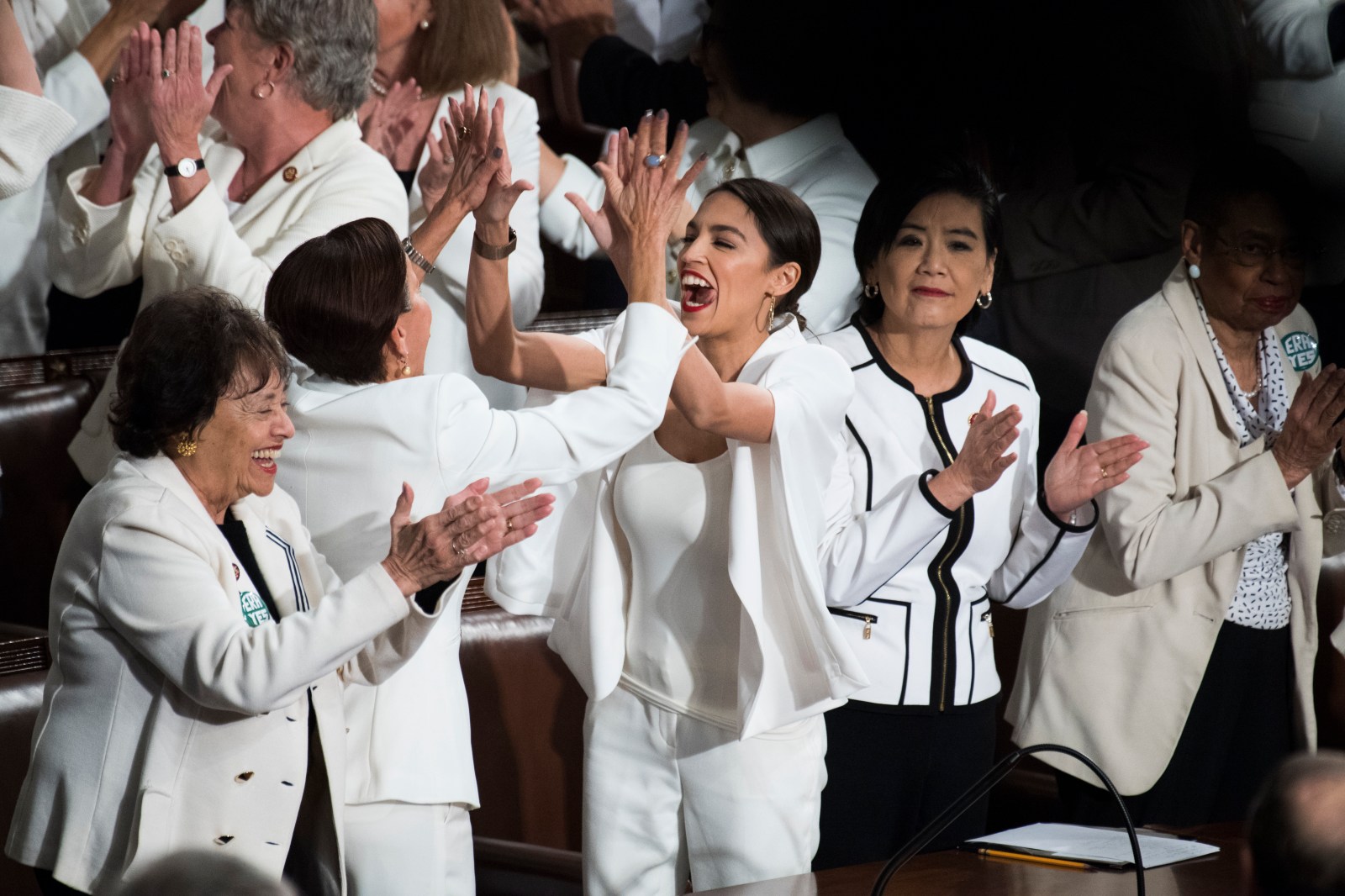
In recent years, Democrats have evolved a distinctive political wardrobe. This transformation reflects various political stances through clothing choices. From reproductive rights to Palestinian solidarity, different attire symbolizes these commitments. For example, at the 2024 State of the Union, Democratic Representatives Summer Lee, Cori Bush, and Rashida Tlaib wore kaffiyehs to support Palestinians. Simultaneously, Democratic women dressed in suffragist white to convey concerns about reproductive rights.
Democratic congresswomen have prominently worn white during Donald Trump’s first term. A notable display occurred at his 2019 State of the Union, forming a coordinated sea of white. They revisited this approach in 2024 and, in February 2026, to protest the SAVE America Act.
Other collections have marked various occasions as well. In 2022, Alexandria Ocasio-Cortez, Ilhan Omar, Ayanna Pressley, and Rashida Tlaib showed solidarity at the Supreme Court, wearing green bandannas with “Won’t Back Down” against the overturning of Roe v. Wade.
During Trump’s 2025 Congress address, Democratic women chose pink outfits. Representative Teresa Leger Fernández called pink a color of “power and protest.” Nancy Pelosi and others displayed this choice while other Democrats wore clothes with messages about monarchy and coups.
In an earlier instance, in June 2020, Democratic leaders like Nancy Pelosi and Chuck Schumer knelt in the Capitol wearing kente cloth stoles following George Floyd’s murder. Though intended as a gesture of solidarity, the image was interpreted in complex ways due to the kente cloth’s cultural significance.
Beyond Washington, in liberal neighborhoods, political clothing speaks volumes. Whether a kaffiyeh, a protest T-shirt, or a tote bag, these items communicate convictions and anger without overt demonstration. Such attire acts as a portable protest sign.
The trend of expressing political allegiance through clothing isn’t new. The red MAGA hat, a notable example, represents Trumpism. Its literal message, “Make America Great Again,” presents a proposition identifying a shared goal among supporters.
Conversely, the Democratic wardrobe frequently communicates opposition. Whether targeting Trump via pink, showing resistance to abortion restrictions with green, or opposing perceived threats to women’s rights using white, the clothing delivers clear stances. This consistent display suggests a party perpetually prepared for protest.
While these causes are significant for many, the broader implication is notable. When political attire emphasizes grievance over policy, it might hinder a party’s ability to propose attractive alternatives. A party aspiring to govern needs more than resistance-oriented merchandise. It must present a vision that resonates beyond mere opposition.
In essence, the Democratic party’s apparel often sends a signal of resistance. However, moving forward, the challenge lies in translating this symbolic attire into a vision that appeals to a wide voter base, suggesting that the focus shouldn’t solely be on the dress code. The emphasis should be on cultivating an image that reflects an ability to govern effectively rather than resist.