
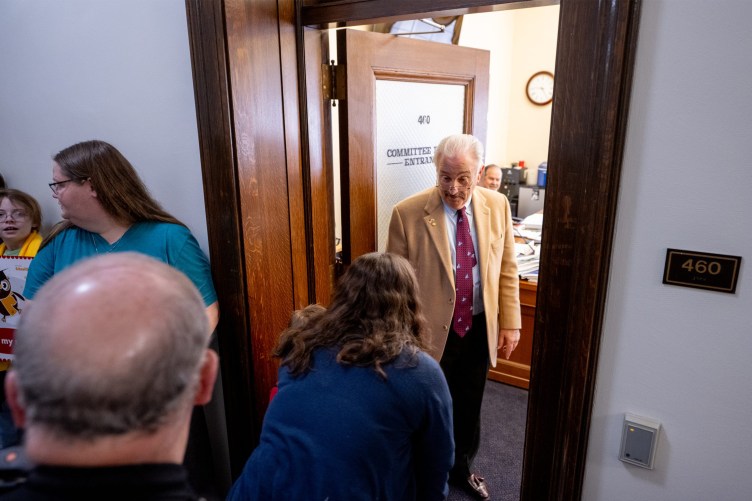
On a chilly February morning in West Virginia’s Capitol, children wearing winter coats gathered with signs and their homework outside the House Finance Committee room. Delegate Vernon Criss, the committee chair, briefly emerged from his office before retreating. Days earlier, Criss, a Republican, introduced a proposal to limit payouts from a voucher program that redirected public tax dollars to private education. In response, families, along with lobbyists and organizers, arrived daily, claiming the proposal threatened the program’s existence. Criss, who supported the Hope Scholarship program’s creation five years prior, did not want that outcome.
The Hope Scholarship, the first educational savings account program without income restrictions in the U.S., was passed with Criss’s support. It started by costing West Virginia $9 million in its first year. By 2026, the cost projection was set to surpass $200 million annually. Criss worried about the program’s unchecked growth amidst tax cuts. The state needed to “face the music,” he noted later. That February, the committee room filled with parents and media. Children sprawled on the floor as discussions unfolded. A delegate questioned whether the Hope Scholarship bill was on the agenda. When Criss said no, attendees left the room. Days later, efforts to curb voucher spending were halted, pressuring Criss politically.
The opposition to Criss can be traced to local and national school choice advocates, whose financial backing influenced events. After Republicans took control of West Virginia’s Legislature in 2015, school choice became a key issue. The Hope Scholarship’s establishment followed six years later, initially enrolling 2,300 students, with 26,000 participating today, surpassing the largest public school district’s enrollment.
Wealthy backers, including the Koch family network and billionaire Jeffrey Yass, fueled the movement. Yass invested over $350 million into political campaigns supporting public funding for private education. This nationwide push met with some Republican resistance. Basic spending limits faced strong opposition.
In the 2026 West Virginia primary, three political action committees (PACs) heavily influenced elections, unseating four incumbent Republicans. Criss, despite his seniority, was defeated. PACs, notably aligned with Koch and Yass, targeted him. David McIntosh, of the School Freedom Fund and Club for Growth, celebrated this outcome, warning Republican leaders against opposing school freedom.
Initially unopposed in 2024, Criss saw over $145,000 spent against him in 2026, aiding a young challenger’s victory. Criss’s proposal emerged as West Virginia public schools faced critical challenges. The Hope Scholarship redirected funding from public schools, exacerbating challenges from declining enrollment. Since 2019, 70 public schools closed, with more expected.
During the legislative session, emergency measures helped one school district stay open without public agitation. The Hope Scholarship’s inception in 2021 saw external influence, notably from lobbyist Jason Huffman, director of Americans for Prosperity-West Virginia. This group, supported by the Koch family, advocated for policies like low taxes and school choice.
“Our goal is to elect champions for school freedom,” McIntosh stated.
Cardinal Institute, a conservative think tank established in 2015, advocated for private schooling. Backed by Koch and Yass-related funding, they supported the Hope legislation with research and columns, collaborating with groups like Americans for Prosperity.
Some parents, seeking alternatives due to personal experiences, joined this effort. Katie Switzer, a mother of six, supported the initiative after her child was diagnosed with a learning disability. Her advocacy featured in promotional materials and she took action when the Hope Scholarship faced legal challenges. The West Virginia Supreme Court ultimately upheld the program, aligning with Attorney General Patrick Morrisey’s defense.
The Club for Growth Action, a Yass-funded super PAC, injected $10.8 million into supporting Morrisey’s gubernatorial campaign. Following his primary victory and success in the general election, Morrisey vowed to expand the Hope Scholarship in his inauguration speech.
Hours before Morrisey’s State of the State address, the House Education Committee reviewed a Rand Corporation report highlighting West Virginia education challenges. Initially limited to public school students, the Hope Scholarship expanded to all residents, significantly elevating costs. Current projections place 2026-27 costs between $230 million and $300 million.
The Rand report recommended income caps and increased public school funding. Criss proposed his own cost-limiting measures, hoping to sustain the program. However, parents galvanized against him. Switzer, influential in the parent community, preemptively warned about damaged schooling options in a Facebook post.
Americans for Prosperity director Huffman publicly opposed Criss’s proposed caps, arguing inflationary effects would diminish the program’s utility. Despite pushback, Criss maintained his proposal aimed to preserve the program’s longevity. Political pressures, particularly from the Republican supermajority, led to the bill’s defeat.
At the root, Morrisey’s administration focused on unseating budgetary and school choice opponents. Campaigns extended beyond educational issues, mischaracterizing Criss’s policies on immigration and social matters. Ads portrayed him negatively, implying adverse state impacts. The School Freedom Fund, alongside other groups, invested substantially in shaping state elections. The governor, tacitly supportive of these efforts, emphasized open educational opportunities.
Ultimately, Criss lost to Charles Hartzog, a young challenger backed by substantial PAC contributions, notably from Sugar Maple PAC, with significant donations from Yass. Despite formidable opposition spending, Criss managed only a long-shot write-in campaign for the general election.