
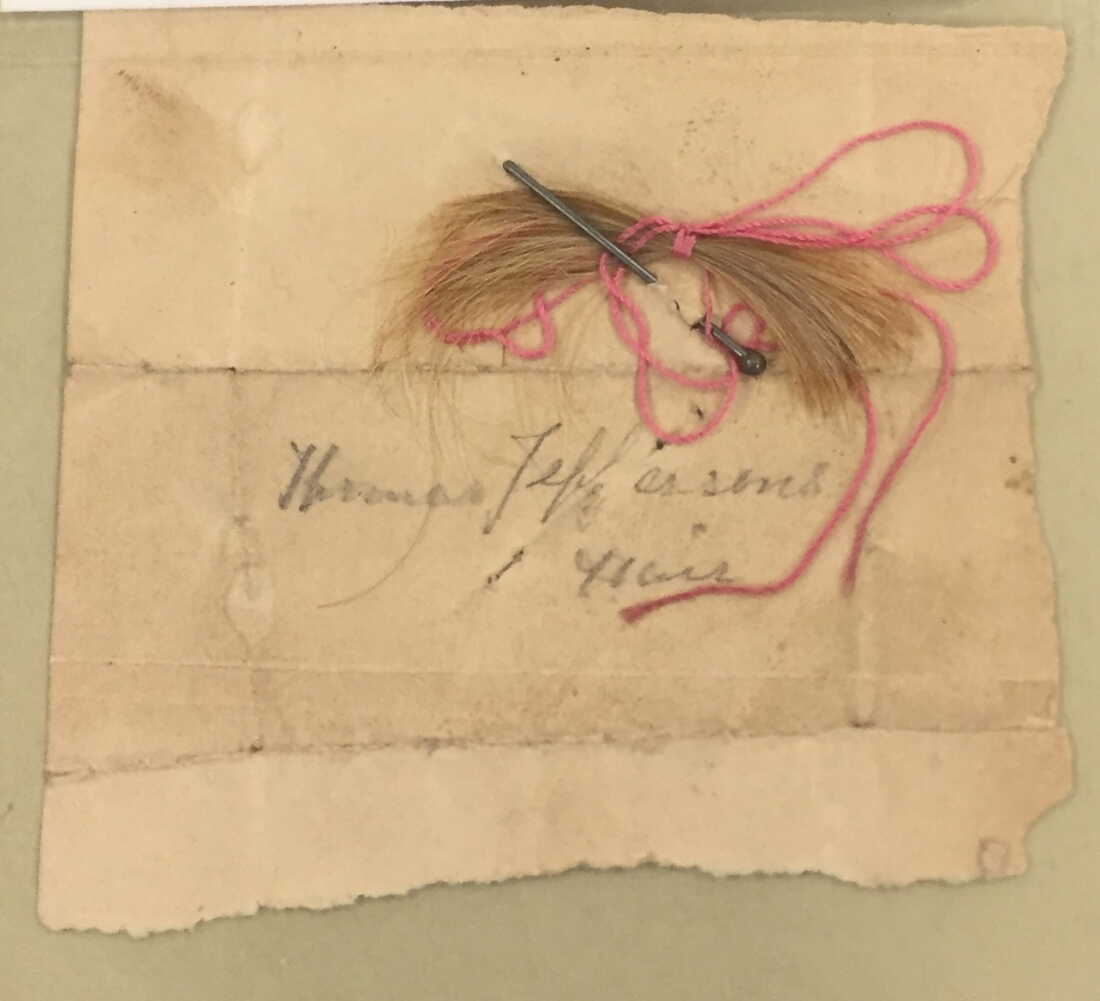
A hair sample labeled as Thomas Jefferson’s, located in the collection of the Thomas Jefferson Foundation at Monticello, has sparked interest in the longstanding question of whether Jefferson fathered children with Sally Hemings, a woman he enslaved and who was 30 years his junior. For over two centuries, this question has intertwined discussions on slavery, race, power, and Jefferson’s legacy. Richard Kurin, a distinguished scholar at the Smithsonian Institution, has focused on applying DNA analysis to resolve this paternity debate.
Jefferson, who authored the Declaration of Independence, often provokes discourse due to allegations linking him with Hemings, which date back to the late 1700s. These allegations have been continuously debated by historians, biographers, and relatives. Pathologist Eugene Foster, in the 1990s, analyzed Y chromosome markers among Jefferson’s descendants and a descendant of Eston Hemings, Sally’s youngest son. The historical and DNA evidence convinced many historians that Jefferson was indeed Hemings’ children’s father.
Yet, objections arose, noting that the Jefferson Y chromosome might belong to any male in the Jefferson family. Non-scientific debates continue over the nature of the relationship, citing the inequality and potential coercion inherent in an enslaved woman’s inability to consent. Despite this, others argue the agency of Hemings, a young woman considerably younger than Jefferson.
Kurin’s research enlisted experts from the University of California, Santa Cruz, like Beth Shapiro and Richard “Ed” Green, employing scientific methods focused on evidence without passing moral judgments on Jefferson. Despite initial setbacks, Kurin discovered a DNA-rich hair sample from Jefferson, assisting in sequencing his genome.
Testing revealed that Madison and Eston Hemings’ descendants possess substantial Jefferson DNA, suggesting he fathered Sally Hemings’ children. However, Sally’s other children, Harriet and Beverly, escaped Monticello in 1822 and passed as white in Washington, D.C., leaving their lineage unexplored.
Kurin’s ambition is to make Jefferson’s genome accessible for public examination, aiding individuals in tracing their ancestry. A paper detailing these discoveries awaits publication. Kurin conveys optimism that the story continues beyond the present, with opportunities for rediscovering obscured heritage.