
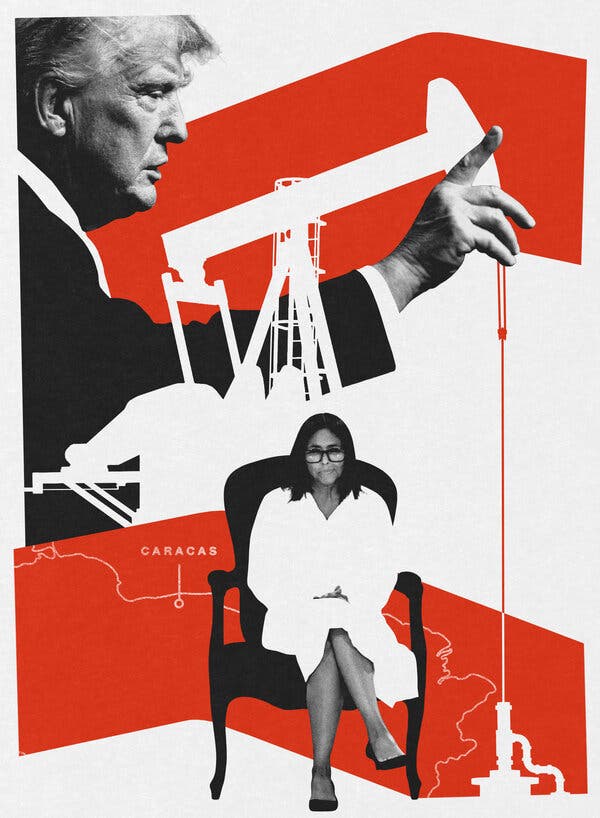
The situation in Venezuela has become a point of international focus since January, when U.S. Special Forces captured President Nicolás Maduro. Following this, American officials and oil executives have frequently visited Caracas. Their goal mirrors historical patterns, where foreign powers influence smaller nations’ governance and economies.
An important figure in this dynamic is U.S. Secretary of State Marco Rubio, who influences Delcy Rodríguez, the acting president. He advises her on government decisions, including employment and economic matters. This involvement extends to opening Venezuela’s economy to U.S. companies, as stated by the Trump administration. They maintain that discussions about democratic elections are premature until economic recovery is secured.
Critics label Venezuela’s current government as a ‘puppet regime’ of the U.S., drawing comparisons to colonial or protectorate arrangements. Economist Carlos Mendoza Potellá likens this to a loss of national sovereignty, with major decisions being made externally. Rodríguez’s government retains formal structures, but its autonomy is questionable. Political scientist Javier Corrales highlights that Venezuela has surrendered economic control to the United States, although it is not under military occupation.
Questions about Venezuela’s sovereignty arise from this complex relationship. Does it remain a sovereign nation, or has it effectively become a U.S. territory? Observers struggle to define its exact status.
This situation exemplifies modern imperial mechanics. Large nations manage smaller states through influence rather than formal occupation, avoiding the high costs and legal challenges of direct control. Tom Long from the University of Warwick points out that maintaining a formal occupation is now costly and complex. Great powers, therefore, adopt alternative methods to exert influence.
In earlier times, sovereignty was seen as an all-or-nothing state. Currently, it is fluid, a ‘bundle of rights’ that can be adjusted or transferred. Smaller states may delegate certain governance functions to foreign powers, as seen around the world. For instance, British companies have managed customs for some African nations, and Australia handled policing in the Solomon Islands. International bodies like the U.N. or I.M.F. often step in when local governance is weak. China and the European Union also exert influence by integrating nations into their economic and political frameworks.