
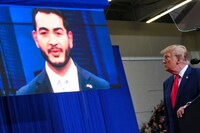
During a rally in Port Huron, Michigan, President Donald Trump criticized Senate candidate Abdul El-Sayed, referring to him as a “jihadist” and claiming he was “on the side of the terrorists.” This rhetoric aimed at Arab Americans has raised concerns, especially as Republicans attempt outreach to this group in 2024. Despite this, there exists a division among Arab Americans, with some perceiving El-Sayed as an “America First” candidate for his stances on foreign policy and domestic economy.
At a Michigan campaign event, Health Secretary Robert F. Kennedy Jr. further alienated Arab Americans by inaccurately asserting that they do not contribute to science and literature. In Dearborn, a predominantly Arab American city, many Trump voters found El-Sayed appealing for his opposition to military aid to Israel. El-Sayed, the son of Egyptian immigrants, has publicly embraced the “America First” label in campaign advertisements on conservative networks.
Meanwhile, several veterans groups have chosen neutrality on Trump’s proposed triumphal arch, which some argue will overshadow Arlington National Cemetery’s site and disrupt visiting experiences. As a U.S. District Judge weighs the arch’s future, opinions remain divided. A recent poll found nearly half of Americans oppose the project, citing potential symbolic harm. Despite this, a federal review panel might soon approve the monument.
In Maryland’s Prince George’s County, plans for a Sphere entertainment venue moved forward after an 8-0 county council vote. This $1.4 billion project is expected to bring significant economic benefits and increase tax revenue, although labor unions are pushing for better worker protections during construction.
Internationally, Egypt’s crackdowns on the press faced criticism from U.S. lawmakers after a court’s order to shut down Mada Masr, a key independent publication. This decision has sparked outcry over free press rights, drawing attention from several U.S. Congress members who demand an end to these hardline approaches.
In Venezuela, Trump claimed a significant oil shipment to Texas as a “gift.” However, the oil is not free but part of a larger U.S.-Venezuela deal aimed at easing gas prices, despite ongoing geopolitical tensions.
Domestically, the FEC’s electronic filing system faced an outage a week before the midterm elections, raising concerns over campaign finance transparency. While the public can still access reports, the cause of the outage remains undisclosed, and the agency’s reduced staffing is under scrutiny.
Trump, preparing for rallies in Texas, hesitated to unconditionally accept upcoming election results. Similar to his past stances, he cited a need for “honest elections” before confirming his acceptance.