
Sweden encountered political uncertainty following a highly competitive election. The left-wing opposition retained a slight lead with votes still being tallied. This election marked a setback for the far-right Sweden Democrats, who lost ground for the first time since entering parliament 16 years ago.
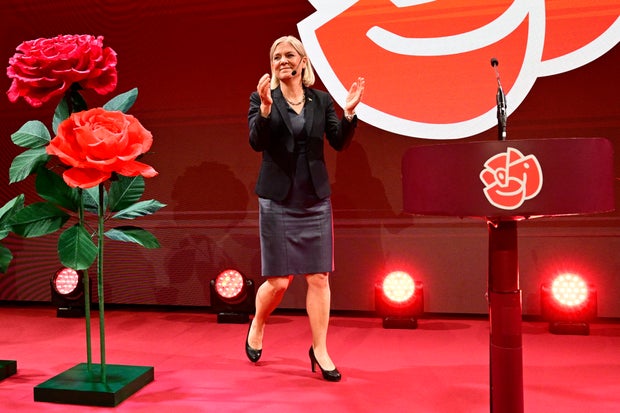
Magdalena Andersson, leader of the left-wing opposition and member of the Social Democrats, expressed interest in coalition options. Similarly, outgoing Prime Minister Ulf Kristersson intended to form a new government through potential coalitions. Both sides needed to make significant concessions to achieve a majority.
Despite the left-wing holding a slim lead, forming a government would involve complex negotiations likely extending for several weeks. The earliest opportunity for parliament to vote on a new prime minister is September 29.
“Sweden’s 2022 election led to government formation in 37 days, shorter than the 134 days required in 2018,” according to election trends.
Political analyst Mats Knutson from SVT anticipated a potential stalemate, possibly resulting in a snap election. “Some parties may need to abandon their ‘red lines’,” he added.
As of Monday, with 95% of votes counted, four opposition parties held a three-seat majority in the 349-seat parliament over Kristersson’s right-wing bloc. The final results could shift as additional votes were pending counting by Wednesday.
“The situation is extremely tight, and political polarization has increased over the years,” commented Mikko Duvaldt, a construction worker, reflecting the challenging government formation process for both sides.
A Culture of Negotiation
If the left-wing majority solidifies, Andersson aims to form a government with three other parties on the left: the Greens, the Left Party, and the Centre Party. The alliance, however, faces ideological challenges.
The Centre Party refuses to back any government including the Left Party, while the Left Party insists on membership in any supported government.
Kristersson plans to approach the Centre Party, historically part of the right-wing bloc, to seek a majority. “Even if tonight’s result remains, I will investigate non-socialist options for government formation,”
Kristersson declared on election night.
Annika Freden, a political science associate professor at Lund University, doubted Kristersson’s success in engaging the Centre Party due to its opposition to alliances with the far-right.
“The parties will strive to avoid a new election,”
commented Freden, emphasizing Sweden’s negotiation culture, which discourages snap elections. Negotiations will focus on compromise and softening rigid stances where needed.
Far-Right Decline
The Sweden Democrats party’s vote share dropped to 17.6% from over 20% four years earlier, placing it third behind the Social Democrats and Kristersson’s Moderates.
Once linked to Sweden’s extreme-right roots, the Sweden Democrats have gradually moved toward mainstream acceptance since 2010 when they first entered parliament. By 2022, they became Sweden’s second-largest party, wielding notable influence without cabinet responsibilities.
Election posters in Stockholm featured Sweden Democrats leader Jimmie Åkesson alongside candidates from various parties.
Observers cited a reduced focus on migration and crime, previously the Sweden Democrats’ strengths, as influencing their diminished popularity. These issues have become widely embraced across political parties since the surge in 2015-2016.
“Migration concerns dominated in 2015-2016, but now more parties favor restrictive policies,” Freden noted, attributing the Sweden Democrats’ struggles to their inability to assert strong stances on other topics.