
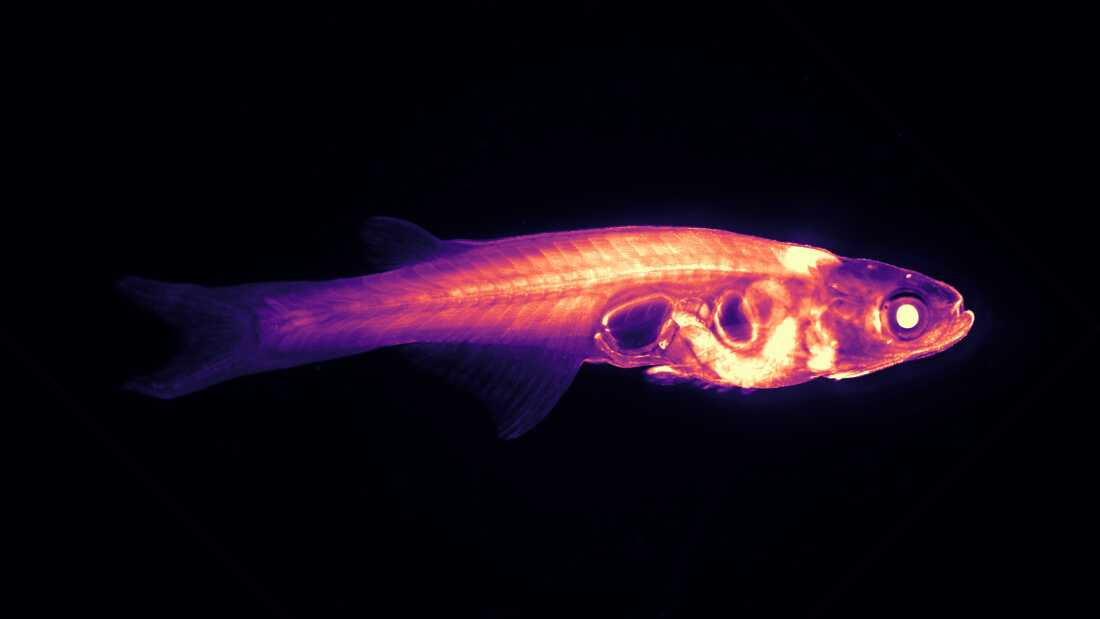
Fluorescent proteins visible inside the transparent Danionella fish enable scientists to observe processes in its brain and body. Researchers at a leading brain science center anticipate that these fish will provide insights into the brain-behavior connection.
A prominent brain science center is focusing on tiny, transparent Danionella fish. The Howard Hughes Medical Institute’s Janelia Research Campus, located near Washington, D.C., has embarked on a project utilizing artificial intelligence and Danionella to explore how the brain governs complex behaviors, such as social interaction.
“It’s a substantial and risky endeavor,” states Gerry Rubin, Janelia’s founding executive director. “But this is what makes it intriguing.” Janelia plans to expand its fish facilities, increasing the space to 6,000 square feet, accommodating thousands of tanks. The number of researchers working on Danionella may grow from about 10 to over 100.
The objective is to observe the entire brain of a fish functioning in real-time. Researchers hope this will reveal how brains drive behavior across different species, including humans. “Our brains share many features with fish brains,” says Nelson Spruston, Janelia’s executive director.
The Brain as a Black Box
In the pursuit of understanding brains, Danionella offers key advantages over more common lab animals, like rodents. In most species, a skull and skin obscure the brain. In contrast, Danionella lacks the top part of the skull and has transparent skin. However, this fish isn’t as well-studied as other models like zebrafish, which are only transparent as larvae.
Recently, Danionella cerebrum, the species preferred by neuroscientists, was officially recognized as a separate species in 2021. It’s appearing in more labs. “An animal with a clear head and body is extremely useful for neuroscience,” says Matt Lovett-Barron, a scientist from the University of California, San Diego, studying Danionella.
Transition from Flies to Fish
Janelia is known for its work on fruit flies, including a project mapping all 54.5 million brain connections in 2024. Now, Janelia is embracing a bold challenge that might unravel a fundamental biological mystery.
The brain-behavior question investigates how neuronal activities lead to memories, experiences, and decision-making. Scientists believe examining the whole brain is essential. “To understand brain function entirely, you must see all neurons firing simultaneously,” Rubin explains. A transparent fish facilitates this, yet it entails analyzing more neurons than those found in fruit flies.
“This will generate vast amounts of data, necessitating artificial intelligence for analysis,” Rubin states.
Advancing Science
Janelia plans to develop tools for studying Danionella, including a map of the fish brain’s connections. This involves creating methods for scientists to collaborate with AI for quicker discoveries.
Currently, scientists immobilize Danionella to study their brains. Janelia aims to change this. “The goal is to conduct experiments with freely swimming animals,” says Spruston. Achieving this requires overcoming engineering challenges.
Scientists already studying Danionella welcome these advancements. Lovett-Barron notes that new tools can help study how these fish synchronize activities, like schooling, using visual information.
“We place our animals in virtual reality environments, akin to video games with social partners,” Lovett-Barron explains. Scientists then observe fish brains managing their social dynamics. Enhanced tools and techniques for monitoring these brains could expedite work, Lovett-Barron says.
Despite progress being a long-term objective, Janelia’s efforts show promise. “I’d be thrilled if in a decade we understand one complex fish behavior, like schooling,” O’Shea remarks. Already, Janelia scientists advance in monitoring numerous neurons simultaneously. Success with larval zebrafish, having about 80,000 neurons, suggests a feasible scale-up for adult Danionella, housing about 650,000 neurons, she notes. In comparison, human brains contain approximately 86 billion neurons.