
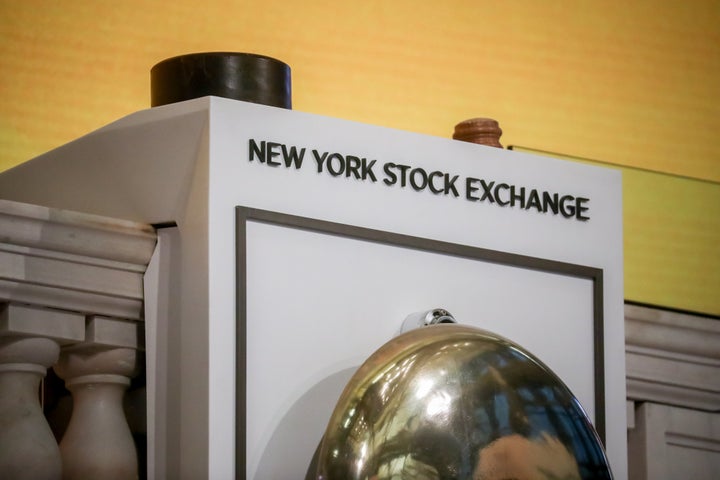
On Thursday, a severe downturn hit Wall Street, heavily impacting stocks linked to AI data centers. This decline erased gains from the previous day, which had been the strongest for the U.S. stock market in three months.
The S&P 500 saw a drop of 4.4%, marking its steepest fall since April 2025, when market instability was triggered by President Donald Trump’s tariffs. The Dow Jones Industrial Average decreased by 1,833 points, equivalent to 3.4%, while the Nasdaq composite fell by 5.5%. This meant the Nasdaq was now 11.9% below its peak from the previous month, entering what is termed a ‘correction’ as it surpassed a 10% loss.
Globally, stock markets felt the effects as those previously thriving in the AI technology boom stumbled, with South Korea’s Kospi index dropping 5.3%. Concerns over AI data center expansion slowed due to rising borrowing costs. Critics argued that AI stock prices had inflated excessively, creating a bubble.
The recent U.S. midterm elections added complications as Democratic victories raised the possibility of halts in data center construction, with voters across party lines expressing concerns over AI and rising energy bills. A halt could reduce the demand for AI chips and other related products, crucial drivers of U.S. economic growth.
Nvidia, representing the AI boom, fell 9.3% and significantly affected the S&P 500. Nvidia is now down 2.6% for the year after substantial gains over the last three years, showing 39%, 171%, and 239% increases annually. Advanced Micro Devices plunged 17.3%, CoreWeave, which rents AI chip access, dropped 9.8%, and GE Vernova fell 7.5%.
AI chip stocks have substantial influence on Wall Street due to their size. A 1% change in Nvidia’s stock price impacts the S&P 500 more than most other stocks.
Despite an initial increase, broad losses occurred towards the end of the trading day. Among few gainful stocks, AppLovin surged 31%, following favorable revenue and profit reports, and announced a stock buyback plan valued at up to $3.6 billion. Tapestry rose 7.1% after exceeding profit expectations and improving its revenue and earnings forecast for the fiscal year.
Overall, the S&P 500 lost 334.89 points to settle at 7,353.73. The Dow Jones fell to 51,523.06 after losing 1,833.06 points, and the Nasdaq composite dropped by 1,421.52, closing at 24,315.00.
Elsewhere in the financial markets, the initial shock from the midterm elections waned. Brent crude oil prices increased by 3.9% to $98.29, bouncing back from an earlier 9% drop. Uncertainty around the conflict with Iran continues, affecting global energy return to normalcy.
In the bond market, Treasury yields kept falling. The yield on the 10-year Treasury declined to 4.84% from 4.90%. Previously, it had been higher at 4.95% the night of the election and over 5.30% the previous month. This likely indicates a shift of investors towards safer U.S. Treasury bonds amidst a stock market decline.
Encouraging economic reports surfaced despite falling yields. Fewer workers filed for unemployment benefits, and a separate report indicated a bigger-than-expected improvement in U.S. labor productivity during the summer, which might support economic growth without adding inflationary pressure.
Internationally, stock markets showed mixed responses in Europe and Asia. Besides South Korea, Japan’s Nikkei 225 dropped 1.8% due to declines in tech and AI stocks. London’s FTSE 100 declined 0.4% after the Bank of England’s first rate hike in three years to manage inflation, largely affected by the Iran conflict causing oil prices to soar. Bank Governor Andrew Bailey highlighted the Middle East conflict’s resolution as crucial for future rate decisions.
AP Business Writer Elaine Kurtenbach contributed to this report.