
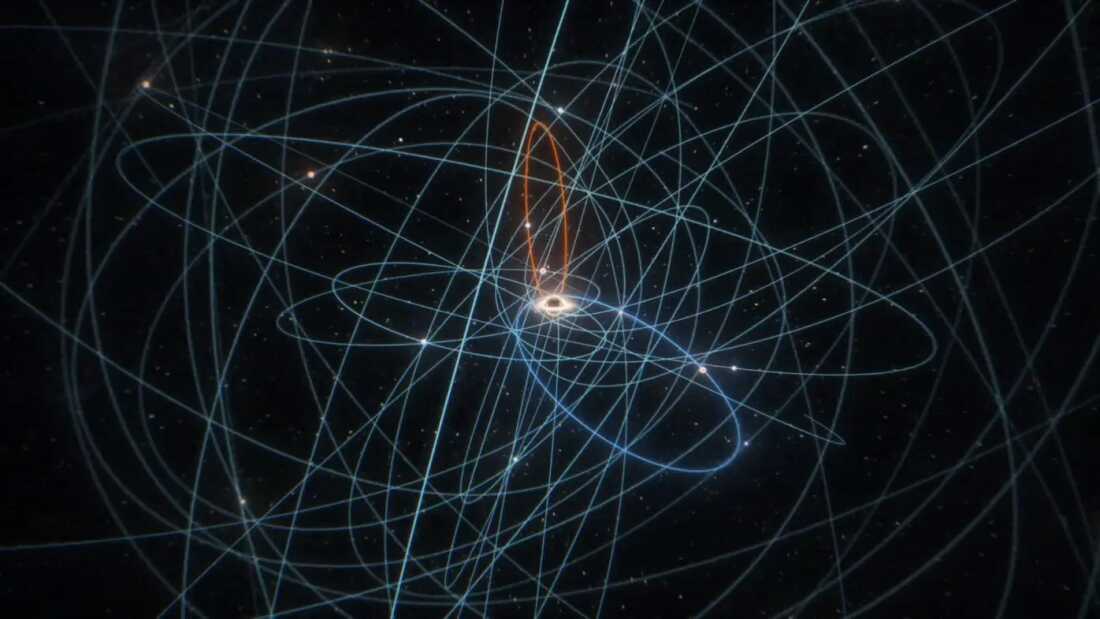
An image highlights the orbital paths of stars circling the massive black hole located at the Milky Way’s center. Among these stars is one named S301, which comes extremely close to the black hole. At its nearest point, S301 travels at speeds exceeding 15,000 miles per second. This observation was credited to the Max Planck Institute for Extraterrestrial Physics.
Back in the fall of 2002, scientists assessed the mass of a colossal entity within our galaxy’s core. They determined its mass to be four million times that of our Sun, effectively identifying it as a supermassive black hole. Stefan Gillessen, an astronomer from the Max Planck Institute, likens its appearance to the depiction in the science fiction film ‘Interstellar.’ He describes it as having a dark silhouette surrounded by a radiant halo.
Black holes pose a challenge visually due to their powerful gravitational pull that prevents light from escaping. Despite this, astronomers have made advances in studying them. In research published in the journal Nature, Gillessen and colleagues discuss the fastest known star, S301, orbiting Sagittarius A*, the Milky Way’s central black hole.
The significance lies in the star’s proximity to the black hole,
says Gillessen. By observing it, scientists visualize the effects of gravity on space and time.
The Black Hole in Our Backyard
Despite their influence, researchers recognize the need to comprehend the nature of black holes and their role in shaping galaxies. According to Gillessen, the Milky Way’s center serves as a prime site for such explorations, offering close proximity for study.
Gillessen’s team utilized four telescopes from the European Southern Observatory in Chile, part of the Very Large Telescope array. Infrared light helped them see through cosmic dust, revealing the core of the Milky Way. Felix Mang, a Ph.D. student, identified a faint yet rapidly moving star within the data.
S301: A Stellar Speed Demon
Mang tracked S301 for years, using Newton’s gravity laws enhanced by general relativity to chart its 8.7-year orbit. The path forms an elongated ellipse with the black hole at one end. As it approaches the black hole, S301 accelerates, reaching speeds near 8% the speed of light, making it the galaxy’s fastest observed star.
Post its encounter with the black hole, S301 decelerates. Its orbital behavior assists researchers in understanding the gravitational field of the black hole. Gillessen likens the orbital precision to the accuracy of Swiss trains.
Illuminating Gravitational Insights
Astrophysicist Erin Kara from MIT finds this discovery significant for future black hole research. It could allow scientists to measure the rotational speed of the Milky Way’s central black hole, revealing more about its origins.
Kara notes that such observations help in understanding how black holes contribute to galactic formation. She emphasizes the dual nature of black holes as exotic phenomena and crucial elements in astrophysics.
Gillessen muses about the sight of such a stellar dance around a black hole. He imagines living on a planet orbiting S301, witnessing the grandeur of the black hole every nine years. Observing its dark silhouette set against the universe’s fabric would be breathtaking.