
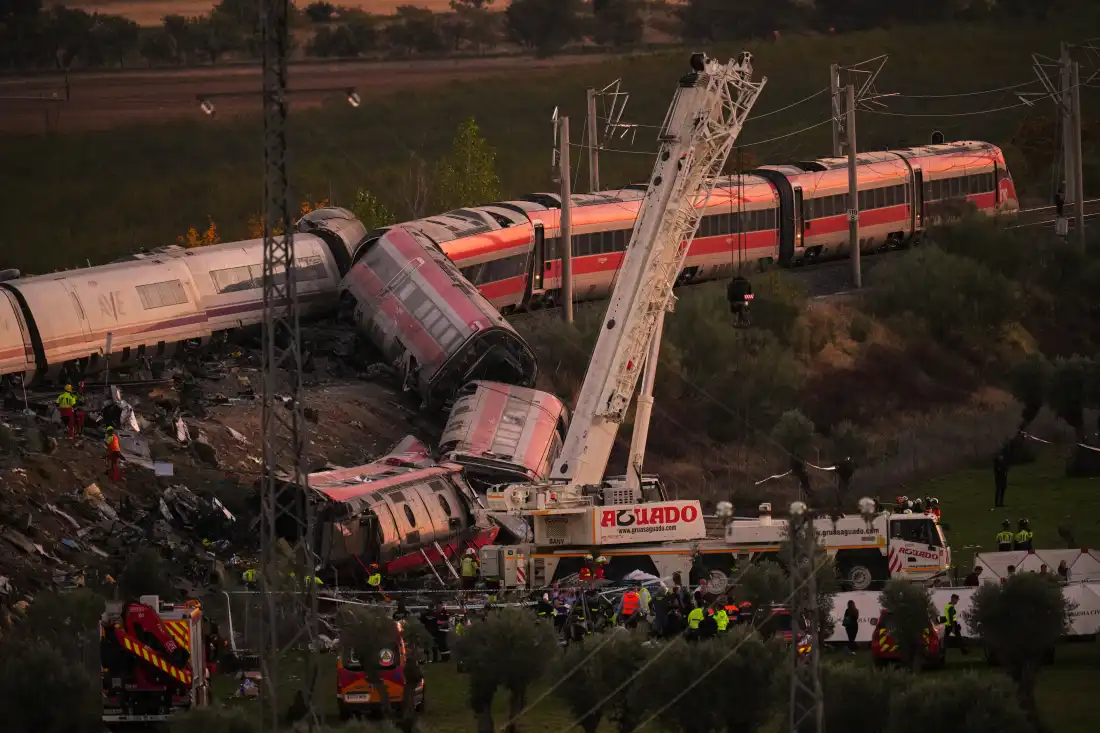
Emergency services responded to a train collision in Urda, Spain, on Wednesday, October 28, 2026. The crash, marking Spain’s second high-speed rail disaster this year, resulted in 68 fatalities. This incident has intensified concerns regarding the safety of Spain’s rail network.
Spain’s high-speed rail system has long been seen as a major accomplishment. It ranks second only to China in track mileage worldwide. For over three decades, until this year, Spain’s rail services had avoided any deadly crashes. The recent collision occurred four weeks prior to a national election.
Prime Minister Pedro Sánchez visited the crash site in Toledo, where regional officials confirmed the death toll and reported that dozens more were hospitalized. Earlier in January, another deadly crash killed 46 people when one train derailed and hit another traveling in the opposite direction in southern Spain.
The graphic above shows the placement of derailed train cars from both trains after the crash and the events leading to it.
Sánchez pledged a thorough investigation and improvements to rail safety. The goal is to restore public confidence in a system that served 45 million travelers last year, including tourists. “Reinforcing the safety of our train service is essential,” Sánchez stated. “Enduring two high-speed train accidents in one year is unacceptable for Spain.” His government has declared three days of mourning starting Thursday.
The two accidents this year involved trains operated by the state-owned RENFE company and the private IRYO. Spain liberalized its high-speed rail services in 2021, with IRYO’s Italian operations beginning in 2022.
Political Challenges for Sánchez
Sánchez, who has faced multiple crises since 2018, confronts another electoral challenge. He seeks re-election amidst a rail disaster that complicates his Socialist Party’s campaign strategy. Previously, they aimed to capitalize on public discontent over housing costs and rents.
On the day of the crash, Sánchez had expressed optimism about Spain in a social media post. Now, he must address concerns regarding rail safety, alongside criticism from right-wing parties about liberal migration policies and accusations of corruption, which he and his wife deny.
Transport Minister Óscar Puente faced media scrutiny over the prospect of resignation but stated his focus remains on managing the aftermath of the collision. Sánchez’s main adversary, Popular Party leader Alberto Núñez Feijóo, demanded a complete investigation. His party also canceled campaign events to honor the victims.
In stark contrast, Santiago Abascal of the far-right Vox criticized the government harshly for the tragedy. He promised accountability for what he termed as government failures.
Emergency services continue to work at the scene of the collision between the two trains in Urda, Spain, on Wednesday.
Human Error Identified
Transport Minister Puente attributed the crash to an “inexplicable” order from a central train command center following a failure in the security system. He clarified that the train engineers were not responsible.
The security system on a 63-kilometer stretch broke down due to computer malfunction at 8:30 a.m., causing all trains to stop. The IRYO train was stationary near Urda, while the RENFE train was 25 kilometers behind.
Despite an active stop signal, central command instructed the RENFE train to proceed without speed limits, leading to the 8:53 a.m. collision with the IRYO train. Puente emphasized that the train should not have received authorization to move, and at the least, should have operated at reduced speed.
By late Wednesday, workers began using cranes to move the damaged train parts, after a day involving emergency responders and military personnel working to rescue survivors and recover bodies.