
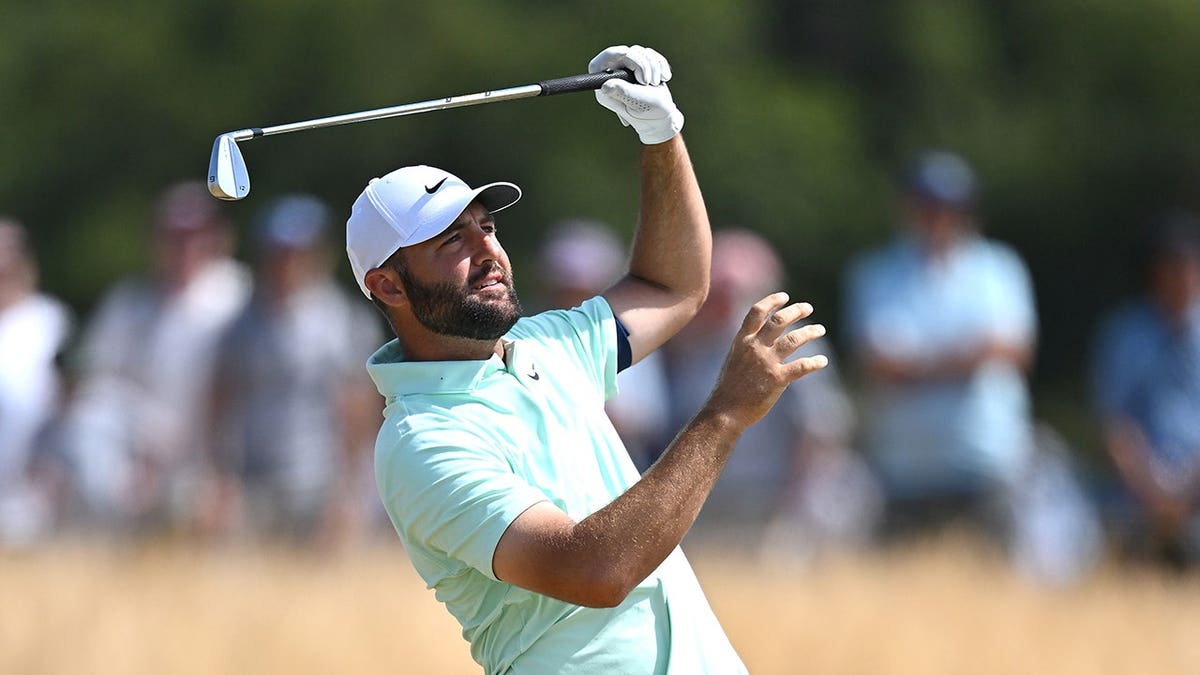
As a leading player in the golf world, Scottie Scheffler’s views on issues carry significance. Recently, many were eager to hear his thoughts on the controversial two-shot penalty given to Bryson DeChambeau during The Open Championship.
Scheffler, who played with DeChambeau in the round where the penalty occurred, has been reserved in stating his opinion. Initially, he mentioned he had little to say on the matter, later suggesting he had much to express, although he preferred to focus on the tournament without his comments becoming a distraction.
The tournament held challenges for Scheffler, with missed opportunities in the early rounds. He rallied on Sunday but faced a tough break, making a bogey on the 18th hole and ending at seven under.
Scheffler, when questioned about DeChambeau’s penalty, defended DeChambeau’s character, stating, “Bryson, I’ve known him for a long time, and he’s a lot of things, but he’s definitely not a cheater.” He emphasized never having seen DeChambeau cheat in any contests they participated in together.
Although Scheffler defended DeChambeau’s integrity, he acknowledged the rules need stricter enforcement and noted that DeChambeau might have been somewhat “careless” with his actions.
He elaborated, saying, “When you’re watching from that camera angle, maybe he was a touch careless around his ball, but I don’t think he did anything intentionally.” Additionally, Scheffler acknowledged that players like DeChambeau face constant scrutiny with each shot documented on broadcast, which increases the chance of penalties for actions that might appear different from various angles.
Other players, such as Russell Henley, agreed, pointing out that not all players receive the same level of camera scrutiny, potentially allowing for slight rule adjustments unnoticed by officials.
Scheffler further exemplified situations like Jon Rahm’s penalty at the Memorial Tournament when a ball moved subtly in the rough, challenging observers to notice with the naked eye.
After defending DeChambeau, Scheffler stressed the importance of returning to golf’s traditional values and enforcing rules more strictly. He explained that growing up, players adhered closely to the rule line. However, some now push boundaries further than appropriate, necessitating more stringent enforcement to uphold the game’s integrity.
In the end, Scheffler’s stance reflects a balance between defending DeChambeau’s actions and acknowledging that the penalty aligns with maintaining golf’s traditions.