
By Craig Fehrman
In recent years, American science funding has faced significant reductions. Last year, the Trump administration either paused or canceled 7,840 research grants according to data from the journal Nature. These were exclusively grants managed by two major funding bodies, the National Science Foundation and the National Institutes of Health. Proposed cuts continue to affect crucial agencies like the Forest Service and NASA, undermining both America’s future and its rich historical legacy of research funding.
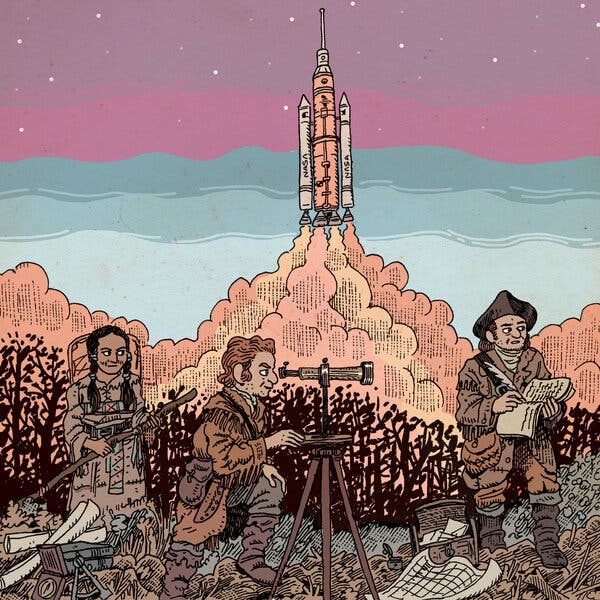
The tradition of public investment in research dates back to 1804 with Meriwether Lewis and William Clark. Their journey to find a trade route from the Missouri River to the Pacific Ocean planted the seed for modern-day research grants. President Thomas Jefferson had to engage Congress to fund this expedition, which would later become influential for both scientific and territorial expansion.
“America’s politicians have debated research funding from the beginning.”
Initially, Jefferson requested $2,500 from Congress, though he anticipated much higher costs. By the end of the expedition in 1806, the War Department calculated the expenses at $38,722.25. Including all documented costs, the total soared to over $100,000—significant considering the federal budget was around $10 million annually at that time. For context, this investment represented a similar percentage of federal spending as NASA does today.
A substantial portion of the funding was dedicated to scientific research. Jefferson tasked Lewis with gathering diverse data and specimens, spanning modern specialties like botany, zoology, geology, climatology, anthropology, economics, and linguistics. Lewis prepared by meeting with scientific experts, as Jefferson believed they might not endure the challenges of such an expedition.
All expedition members participated in the research. Clark contributed maps and measured astronomical observations with precision. Sacajawea, a Shoshone woman, collected botanical specimens. York, a Black man enslaved by Clark, gathered various invertebrate specimens. Lewis, with his focused and meticulous nature, led the charge, documenting the physiological changes in animals, insect behaviors, and mineral compositions.
Despite the immediate scientific rewards, the expedition had underlying imperial motives. Jefferson understood that scientific discoveries would bolster America’s territorial claims, influencing international perception and future expansions, often disregarding Native suffering associated with such growth.
The expedition’s findings immensely benefited America, especially the fur trade. Lewis’s insights led traders to establish commerce hubs along the Pacific Coast. While Clark believed he identified a viable road, the Oregon Trail’s crucial mountain pass was discovered elsewhere by a trader influenced by the expedition, demonstrating research’s inherently unpredictable nature.
The legacy of Lewis and Clark underscores the importance of research funding, not only for scientific advancement but also for national development.