
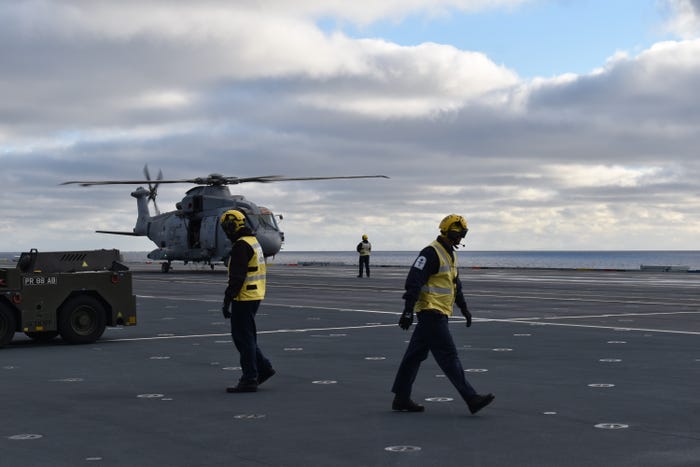
Sailors aboard the HMS Prince of Wales are navigating challenging conditions in the Norwegian Sea. Training exercises are underway as part of Operation Firecrest, aimed at bolstering NATO’s presence in the Arctic and North Atlantic.
Fog covered the Norwegian coastline, creating a stark backdrop as a British helicopter flew over the cold waters. The helicopter, a Merlink Mk4, landed on the HMS Prince of Wales, where sailors in protective gear managed F-35 fighter jets amidst falling temperatures.
The ship, a key element of the UK’s carrier strike group, participates in exercises designed to enhance readiness. These operations take place in the High North, where decreasing daylight and escalating Russian military movements increase the challenges.
Captain Ben Power, the commanding officer, highlighted the environment’s complexity during a bridge interview. “The High North is a complex environment,” Power stated. The crew must operate without radar or radio signals, honing skills essential for combat proficiency.
NATO’s Arctic and North Atlantic operations counter growing Russian naval actions. Monitoring Russian submarines, particularly those from Murmansk, remains a priority. These submarines navigate strategic routes, including the GIUK gap, a crucial area for NATO’s presence.
“We’ve noticed an increase in Russian activity across multiple domains,” Power remarked. He further stated that Russia persists as a credible threat across these operational zones.
Western naval officers note that harsh conditions, such as poor visibility and strong seas, affect operational capabilities. Regular training in the High North is vital to test and prepare crews for these elements.
Commodore Richard Hewitt, leader of the UK’s carrier strike group, praised the team for managing the taxing environment. In the preceding summer, HMS Prince of Wales supported Arctic Sentry, a NATO operation enhancing High North security.
“The focus this year has been on the High North,” Hewitt commented. “We expect this emphasis to continue in the North Atlantic.”