
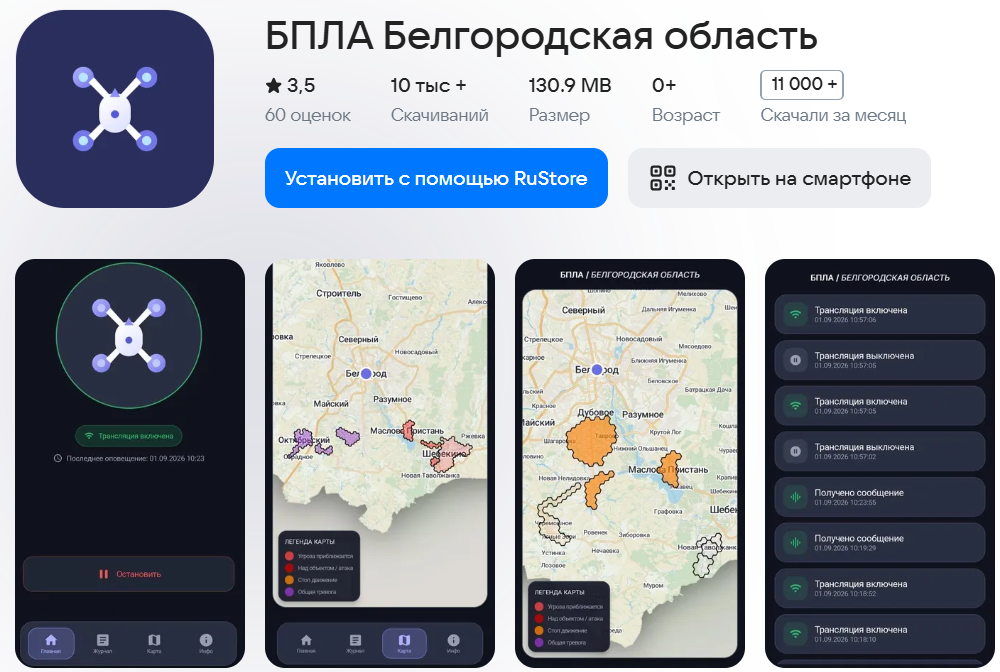
Russia spans vast distances, leaving some citizens in remote areas of the Far East unaware of the war their nation wages. For those in Belgorod, such ignorance is not possible. Located just north of Ukraine’s Kharkiv, this Russian region serves as a crucial supply route for troops. Now, it endures relentless Ukrainian drone attacks. In response, Belgorod’s Digital Development Ministry launched an app designed to warn residents of incoming UAVs and highlight danger zones on a map. But, the app faces major hurdles due to restrictions.
The app, named “BPLA Belgorod Region” featuring the Russian acronym for UAV, was introduced on Russia’s RuStore marketplace on September 1. Its functionality includes a downloaded map of Belgorod and alerts users to potential drone strikes via auditory notifications. With the region witnessing 269 drone attacks on September 6 alone, it is needed. Unfortunately, the app’s operations are stifled due to restricted mobile internet connections, implemented ostensibly for security reasons.
Authorities claim that limiting mobile internet is vital for security, as cellular networks may assist drones. However, this also enables the government to control what Russians access online. Alongside curbing foreign social media and VPN attacks, these shutdowns are another way for the Kremlin to centralize the information flow. While authorities maintain lists of approved websites accessible during shutdowns, user reviews on RuStore reveal the drone-alert app hasn’t been approved yet.
User Review: “The app is good, and most importantly, it’s USEFUL! But there’s one big BUT: whitelisting! As soon as whitelisting is enabled, the app immediately becomes useless. PLEASE whitelist this app or allow VPN use,” wrote Vyacheslav.
Reviews pointed out that apps only notifying users while already indoors are flawed. Other criticisms include Wi-Fi issues, signal losses, startup failures, and sound notification glitches. Complaints cite that the app often refuses to open or operate effectively without internet. These problems illustrate how unprepared Russian authorities were when Putin commenced the military operation.
In comparison, by March 1, Ukraine marked the fourth anniversary of its “Air Alert” app, an efficient tool warning citizens of Russian attacks. Developed in mere days amidst advancing Russian forces, it achieved 2 million downloads within a week.
While Ukraine’s solution stands robust four and a half years into conflict, Belgorod’s residents cope with an unreliable app despite regular attacks since early 2025. This app’s struggles are symptomatic of Russia’s lack of preparation for the war’s domestic fallout. Last week, the government included counter-drone technologies in postal service equipment—an unexpected move thrusting postal officials into air defense roles.
The Kremlin initially portrayed the invasion as a detached action, suggesting Russians could witness it without facing consequences. However, the realities of war are manifesting much closer to home for the citizens in Belgorod and beyond.