
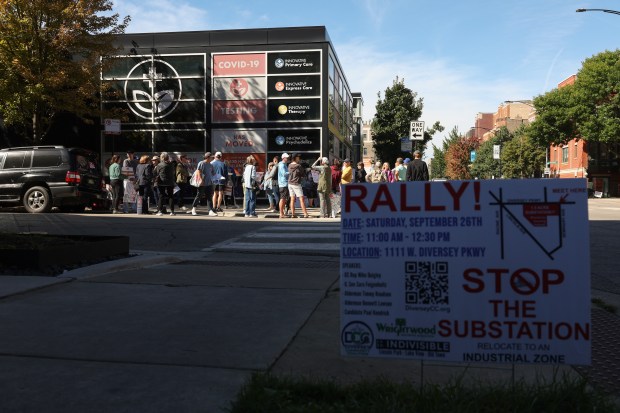
The residents of the North Side, taking to Diversey Parkway, acknowledge that their electrical grid is nearing its limits. They agree on the necessity of a new substation to supply power to homes and businesses, yet they insist it should be located elsewhere. Mary Driscoll, an 81-year-old Lakeview resident of over 50 years, points out the difference between resisting unwanted utilities and the exclusionary tactics that maintain neighborhood wealth and segregation. ‘The community has united positively,’ she asserts, ‘not in a ‘Not In My Backyard’ manner.’
Driscoll, part of a local movement involving thousands, opposes ComEd’s plan to construct a substation at 1111 W. Diversey Parkway. ComEd argues the spot is optimal for preventing power outages, while locals believe housing should take precedence. The debate presents conflicting views, with residents accusing ComEd of misrepresentation, and the utility claiming misunderstandings about the project. Driscoll, with the Diversey Community Coalition (DCC), emphasizes more than just electrical infrastructure in their protests.
The grassroots DCC opposes accusations of NIMBYism, instead adopting ‘THIMBYism’—’Transit-oriented Housing In My Backyard.’ During a Lincoln Park gathering, organizers warned of potential noise and fire hazards from the substation, leaving room for hope that the site could host housing in the future. Young residents like Emilia Rosenberg, 10, express a desire for a ‘beautiful, safe neighborhood’ opposed to a ‘gross, smelly’ area.
Working with local officials, the coalition has submitted numerous public comments to the Illinois Commerce Commission, temporarily halting ComEd’s plans. Their proposal touts possible development of 200 apartments supporting over 450 residents, including affordable options. Estimated to boost neighborhood spending by $5 million annually, these figures are supported by Alderman Timmy Knudsen but lack professional developer input.
Chicago zoning expert Edward Kus critiqued the housing proposal, suggesting the site couldn’t support the planned scale under current zoning. ComEd, owning the $11.5 million site since 2021, can legally build the substation there. Approval of project size and cost by ICC could enable ComEd’s plan, with Knudsen hopeful for ComEd’s eventual willingness to sell—though utility executives deny this possibility.
‘We aim to receive their feedback on the design,’ remarked Keisha Parker, ComEd’s vice president of external affairs. ‘This isn’t a conflict for us. This is the chosen site.’
Community efforts continue beyond proposal opposition, marked by ‘STOP THE SUBSTATION’ and ‘WE WANT HOUSING’ signs across Lakeview and Lincoln Park. Initially focusing on replacing a vacant COVID-19 test site, the group flagged potential risks from substations, citing past failures despite the fact that authorities, including WHO, have found no direct health link.
In response, ComEd emphasizes upgraded safety in modern substations, contrasting previous infrastructure. Parker notes substations as a common city feature, often inconspicuously situated near schools. Reconstructing on the current site minimizes disruption and conserves time and cost.
Despite ComEd’s standing firm on location, the coalition highlighted 14 alternative sites from exhaustive citywide research. Although reviewed, ComEd found all inadequate, arguing moving could cost up to $270 million, with additional expenses impacting customers. This resistance stems from the idea that prominence shouldn’t dictate solutions.
Real estate broker Andy Ogorzaly explains Lincoln Park’s declining population amidst rising housing demand, attributing it to shifts toward luxury housing over multiunit developments. Awaiting a decision from ICC, the DCC is encouraged by questioning of ComEd’s project portrayal. Despite differing views on substation necessity and location, Parker outlines the need to clarify, allowing collaboration on design while acknowledging essential infrastructure responsibilities.
The situation, initially about avoiding undesirable developments, has evolved into contemplating community-friendly solutions. Federico Massai, a local resident, observes the complexity of the situation, ‘Rallying around the truth they choose to believe.’