
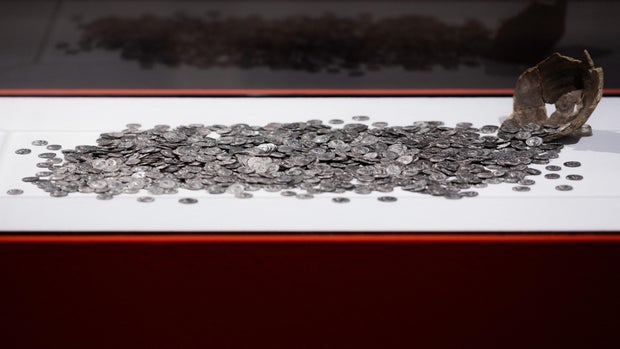
An amateur archaeologist in Germany made a significant find when he discovered Roman silver coins in a western field, leading to an extensive excavation. Oliver Riedl, equipped with his metal detector, uncovered multiple coins, prompting him to inform the authorities. A professional team soon arrived and unearthed a total of 934 Roman silver denarii, marking the largest find of its kind in Germany from the era of Roman Emperor Hadrian.
The Digging Begins
Riedl explained that his metal detector continuously signaled more coins near Wesseling, located south of Cologne. This discovery occurred a year ago, and the coins total 3.1 kilograms (6.8 pounds). They are now exhibited at the LVR-LandesMuseum Bonn.
Most of these coins are linked to the time of the Flavian emperors (A.D. 69–96), with the earliest minted in 148 B.C., according to a museum statement. This Roman coin hoard was likely buried intentionally during the second quarter of the second century A.D., as stated by the LVR Office for the Preservation of Archaeological Monuments in the Rhineland.
“Of course, we can only speculate about the motives, but it’s very likely that someone wanted to keep this money safe. After all, banks didn’t exist back then,” said Erich Classen, state archaeologist and director of the office.
The reasons for the treasure’s lack of recovery remain unknown, possibly due to the owner’s death, hindering the transfer of its knowledge. Finds from ancient Roman times are not unique. However, this one stands out due to its magnitude.
Value and Historical Context
Determining the hoard’s precise value during ancient times is a challenge. Comparisons with Roman legionaries’ pay provide insight. Rahel Otte, a research associate, noted, “At that time, an ordinary soldier in the legion earned 300 denarii a year. However, about half of that was withheld for food and equipment.” A legionary would require six years of savings of disposable income to accumulate the Wesseling hoard.
The origin of this considerable wealth still puzzles researchers. The Cologne area fell under Roman rule circa 39 B.C. until A.D. 459, secured by General Marcus Vipsanius Agrippa to strengthen the Rhine River border.
Roman Treasures Across Europe
In recent years, Roman-era treasures have emerged across Europe. In February, metal detectorists in Wales unearthed two Roman-era lead ingots, marking the first finds of their kind in the region. In 2024, central England revealed a Roman coin hoard valued at over $125,000 during a construction project. Additionally, Polish metal detectorists discovered a significant cache of ancient Roman coins. That same year, a collection of ancient silver Roman coins surfaced on a small Mediterranean island.
These discoveries highlight the enduring impact and widespread reach of the Roman Empire, providing valuable glimpses into its historical wealth and influence.