
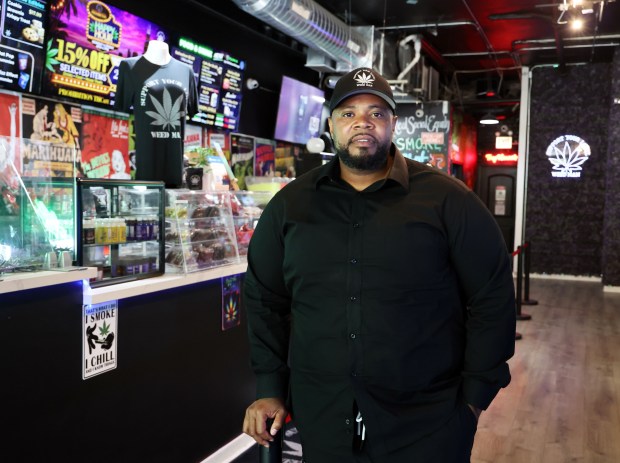
Samuel Wilson’s Business Under Threat
After federal law permitted hemp in 2018, Samuel Wilson co-founded Prohibition THCafe on the Near South Side. His business offers hemp-derived THC edibles and drinks. For April 20, an informal cannabis holiday, the cafe collaborated with Harold’s Chicken to serve infused wings, attracting significant customer interest.
Recently, Wilson’s business faces closure due to impending federal and state measures. A new federal law aims to restrict intoxicating hemp sales. Additionally, Illinois lawmakers approved a bill requiring only state-licensed dispensaries to sell hemp products. This bill, pending Governor JB Pritzker’s signature, seeks to eliminate unregulated shops selling untested hemp to minors. Wilson, who maintains he only provides quality-tested products to adults 21 and over, expresses concern over the potential closure of small operators like himself.
“I was that innovator who chased the American Dream,” Wilson said.
Impact of Proposed Legislation
The legislation represents a victory for licensed cannabis businesses. These businesses have long argued that unregulated hemp shops undermine their sales without facing security and testing requirements. Cannabis operators have supported this comprehensive legislation as a necessary correction. It’s considered the most significant development in the industry since Illinois legalized recreational cannabis sales in 2020.
The state ban on intoxicating hemp is broader than the federal restriction, which limits sales to products with no more than 0.4 milligrams of total tetrahydrocannabinols. Both regulations are set to be enacted in November. Wilson hopes for federal amendments to allow continued hemp sales, though changes will be difficult to achieve. In any scenario, the Illinois law will halt unlicensed hemp sales.
Economic Influence of Hemp and Cannabis in Illinois
Hemp businesses have flourished within the Illinois market. Over 1,000 hemp retailers have contributed around $870 million in sales and roughly 13,000 jobs, according to a Whitney Economics survey. The licensed cannabis side, primarily led by larger corporations, is set to see changes from the Illinois “omnibus” bill. This includes doubling the allowable quantity of cannabis or THC consumers can possess.
For Illinois residents, the legal possession limits would increase to 60 grams of flower, 1,000 milligrams in edibles, and 10 grams of concentrate. Out-of-state individuals may possess half these quantities. Additionally, dispensaries could extend their operation hours to 2 a.m., subject to local regulations.
Benefits for Medical Cannabis Users
A significant change is the ability for any licensed dispensaries to offer medical cannabis, avoiding high recreational taxes. This expansion remedies the inconvenience of long-distance travels required for specific tax-exempt dispensaries. The reform potentially allows newer dispensaries to benefit from standard business tax deductions, leveraging federal changes in medical cannabis usage restrictions.
Furthermore, the bill introduces drive-thru service and permits cannabis in cars if packaged securely.
Industry Reception and Future Licensing
Tiffany Ingram, executive director of the Cannabis Business Association of Illinois, praised the regulatory overhaul. She emphasized the bill modernizes outdated protocols and restricts external intoxicating hemp sales.
“Senate bill 3222 accomplishes both, making it one of the most consequential cannabis bills since legalization,” Ingram stated.
For hemp entrepreneurs, there will be an opportunity to secure one of 145 new licenses allowing the sale and infusion of THC products like edibles and beverages.
State Sen. Kimberly Lightford, an advocate for stricter hemp policies, declared the changes both cement and modernize the hemp market while reducing entry barriers for patients and new operators. If signed into law, the bill will immediately prohibit intoxicating hemp sales to minors and ban misleading marketing targeting youngsters. It also eliminates the dispensary requirement for costly security contractors, enabling in-house security options, according to state Rep. Will Guzzardi.
Given the limited resources of federal agencies to enforce the hemp ban nationwide, enforcement will heavily depend on state regulators and local law enforcement, presenting potential challenges.