
Pierre Coffin, a filmmaker, is the creator and leading voice behind Minionese, the whimsical language spoken by the Minions. Developing this dialect took time and effort. “I have a file on my phone with Indian dishes and strange words,” Coffin shares. “People often suggest words, and I note them down.” He notes the challenge lies in finding the right tone.
Since co-directing Illumination’s “Despicable Me” 16 years ago, Coffin has expanded the franchise with three more films, including “Despicable Me 2,” “Despicable Me 3,” and “Minions.” Despite their popularity, Coffin finds the Minions both fascinating and perplexing, akin to his version of Frankenstein’s monster. He resides in Paris, where he faces the challenges of Hollywood’s franchise system and the unique narrative hurdles presented by a series featuring a supervillain with gibberish-speaking assistants.
“That’s why I stepped back from the series,” Coffin stated from Paris. “The first film had a compelling story: a villain turning good after interacting with three girls. The sequel was harder to justify—that ex-villain now in love and getting married, as pitched by Chris Meledandri, didn’t sit well with my French sensibilities.” Coffin is candid about his critical perspective, even toward films he directed, like the “Minions” spinoff from 2022. He admits he doesn’t enjoy discussing it, saying, “I don’t necessarily like it.”
His last directorial effort was “Despicable Me 3” in 2017. “After that, I told Meledandri I needed to move on. I completed my trilogy and prequel. I’m satisfied. I can contribute with voice work if needed, but I have other projects,” Coffin explained. Despite efforts to distance himself, the Minions keep pulling him back.
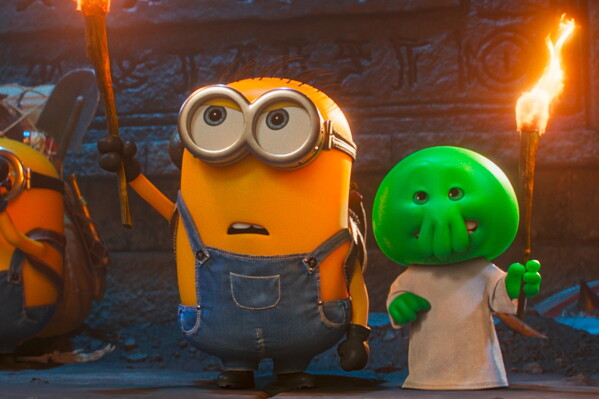
In “Minions & Monsters,” releasing on Wednesday, it seems the franchise may have reached its peak. The plot involves the Minions as filmmakers, collaborating with icons like Charlie Chaplin and Harold Lloyd in 1920s Hollywood to create a monster movie. The premise, suggested by Meledandri, was irresistible for Coffin. He wanted to write the script and did so alongside Brian Lynch.
Coffin notes that the Minions are now more than mere sidekicks. They have become silent film stars and genuine protagonists. “For those who grew up with the Minions, this movie delivers both their trademark silliness and a compelling story,” Meledandri says. Despite numerous films and over $5 billion in earnings, Coffin continues to uncover the layers of the Minions’ evolution.
They transitioned from hulking figures to robotic models, eventually evolving into the mole men-like characters known today. Coffin, alongside Chris Renaud and Eric Guillon, refined them to include distinctive features like goggles and overalls. Naming them Stuart and Kevin helped solidify their place in cinematic history.
The Minions’ speech, Minionese, complicates their role as protagonists. It requires careful balance, as long sequences can become tiresome without human interaction. “Too much jargon is cut,” Coffin explains. “We repeated the process until finding the precise formula.” He improvises all Minion voices, typically recording dialogue solo for hours before heading to the studio. Writing dialogue on paper proved less innate.
Working with Lynch, understanding how to effectively write for the Minions was a learning experience. Initially, Lynch tried to script gibberish directly. “I told him, ‘Write it in English so it’s understandable.’ Establishing that took time,” Coffin recalls. The Minions, though mascots for Illumination and hugely profitable in merchandise, remain dear to him. According to Coffin, “They aren’t creatures—they have spirit and personality.”
In “Minions & Monsters,” Coffin reflected on friendship, finding that many friendships form in childhood. “Realizing this, the Minions became like children,” Coffin discovered. “They’re irresponsible, messy, defiant. This understanding made portraying them easier.”