
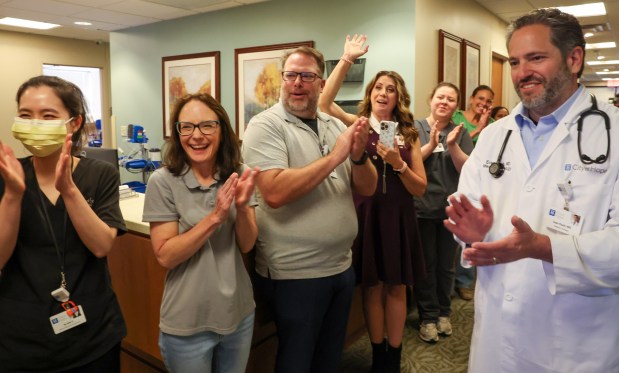
When Rachelle Gardner heard about an experimental drug for pancreatic cancer, she tried to manage her expectations. Her concerns were many: eligibility, hospital approval, and her own time. In late July, she received her answers. Inside an exam room at City of Hope Cancer Center Chicago, Gardner took three light blue pills from a bottle, swallowing them with water. ‘To good health and getting rid of that cancer bug!’ she exclaimed after taking the last pill.
Gardner, a 59-year-old teacher for the visually impaired from Milwaukee, described the medication as giving her ‘a new sense of hope.’ She is among many patients in Illinois and across the nation now receiving this drug, dubbed daraxonrasib. This medication, while not a cure for one of the deadliest cancers, offers patients something nearly as valuable: more time to live.
Pancreatic cancer, once it spreads beyond the pancreas, can limit patients’ lifespans to just months. But a recent clinical trial gave hope. Patients with metastatic pancreatic cancer who were treated with daraxonrasib lived a median of about 13 months after joining the study. This contrasts with a median of six months for those who continued with additional chemotherapy instead.
“This is honestly a game changer,” stated Dr. Evan Pisick, a medical oncologist at City of Hope Cancer Center Chicago. “This changes what we can offer patients, marking a significant advance in pancreatic cancer treatment.”
Even though the FDA has not yet approved the drug, it allows Revolution Medicines to provide it to eligible patients through an expanded access program. Physicians must request the medication for individual patients. The drug is offered at no cost within this program. ‘It gives patients the opportunity not to wait because time is something many don’t have,’ Pisick explained.
Gardner is one of several patients at City of Hope receiving the drug, Pisick noted. Other health systems in Illinois, such as Advocate Health Care, OSF HealthCare, Endeavor Health, and University of Chicago Medicine, have also started administering the medication under the program.
Dr. Ardaman Shergill, a UChicago Medicine oncologist and clinical trial lead investigator, described the drug’s impact as ‘unprecedented in pancreatic cancer.’ ‘Our goal in oncology is to help patients live longer. Extending life is crucial,’ said Shergill, emphasizing reported improvements in pain, appetite, and energy for patients using daraxonrasib compared to chemotherapy.
Among those benefiting is 84-year-old Mary Louise McAdams from Bronzeville. Diagnosed in 2024, she initially faced a grim prognosis of six months to a year. Despite undergoing chemotherapy and radiation, the treatments were hard on her body, at times leading to hospitalization. ‘I hope to prolong my life as long as I can remain functional,’ McAdams shared.
For Gardner, the journey began with a strange rash and subsequent diagnostic tests, leading to a Stage 1 pancreatic cancer diagnosis in 2023. ‘We looked at each other and started crying,’ she recalled of hearing the news with her fiancé.
Gardner endured chemotherapy and a Whipple procedure, hoping for a reprieve. Though initially showing no signs of cancer, by spring 2025, it returned at Stage 4. With chemotherapy and radiation losing effectiveness, she faced a bleak outlook until learning about the application for daraxonrasib at City of Hope.
‘Clinical research is critical,’ stated Robert Stone, CEO of City of Hope. ‘Programs like clinical trials and expanded access can become the best options for timely treatments.’
Now, taking the daily medication, Gardner remains hopeful. She’s eager for more time with her fiancé, to explore, teach, and share moments with her family. ‘There’s hope out there,’ she shared.