
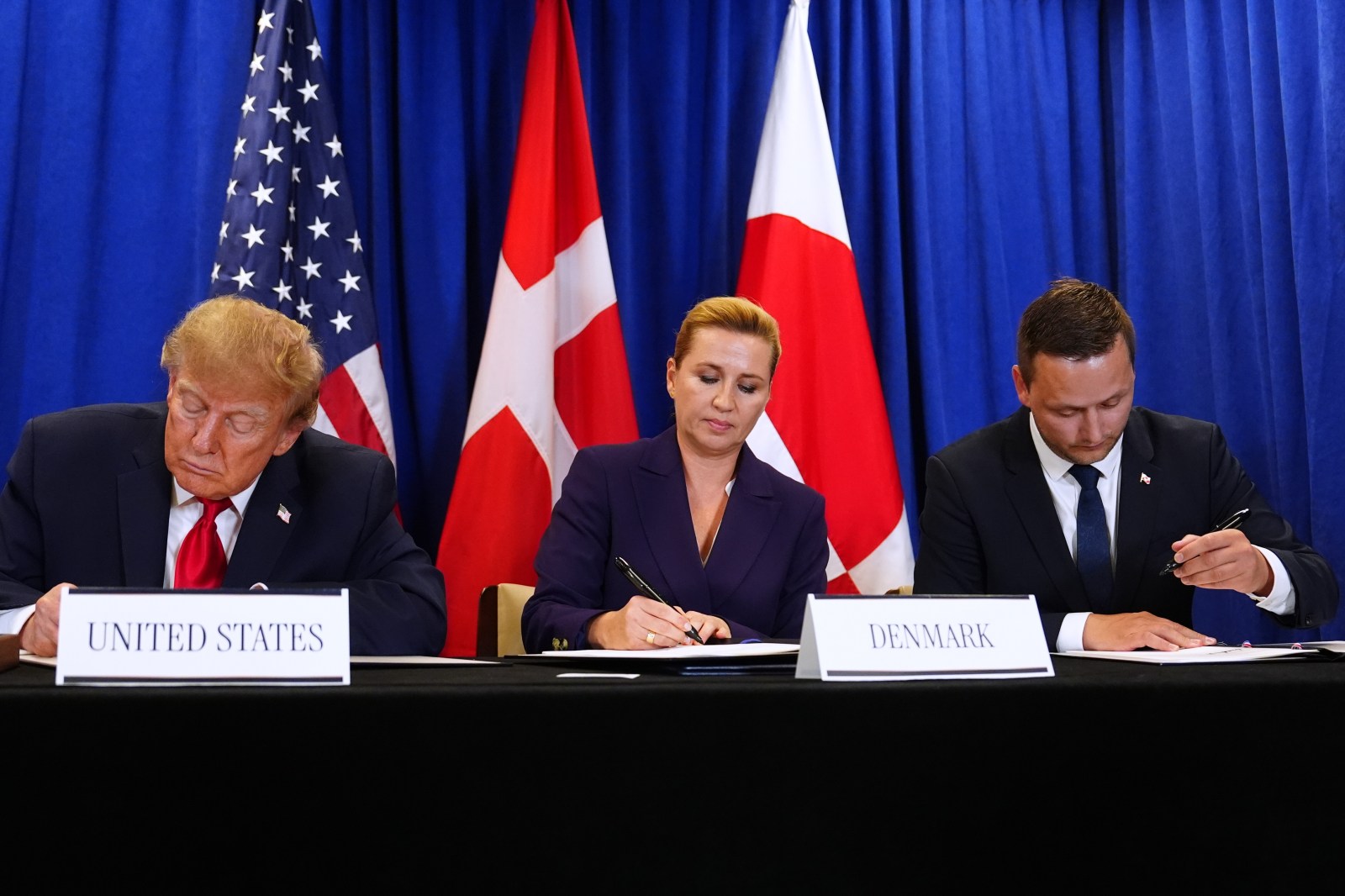
President Donald Trump finalized a security agreement with Denmark and Greenland, expanding U.S. military operations on the Arctic island. This agreement builds on a 75-year defense treaty governing American military access.
Details of the Agreement
Signed during the United Nations General Assembly in New York, this pact creates new American defense sites and secures a long-term role for the U.S. in Greenland’s security. Unlike the 1951 U.S.-Danish Defense Agreement, this agreement includes Greenland, granting the U.S. veto power over certain foreign investments.
No U.S. adversary will establish a military presence in Greenland any longer without our approval,Trump asserted in his U.N. speech.
The U.S. plans to construct two major military bases on Greenland, still under Danish control. Denmark emphasized that the arrangement acknowledges the Kingdom of Denmark’s sovereignty and Greenlanders’ self-determination rights.
The 1951 U.S.-Danish Defense Agreement
Signed as part of NATO’s security framework, the original agreement permitted the U.S. to establish defense zones in Greenland with rights to build and operate military sites, maintain personnel, and conduct military activities. It preserved Danish sovereignty over Greenland.
During the Cold War, the U.S. operated many installations on the island. A significant presence involved 17 installations and over 10,000 personnel. Currently, the American presence is centered on Pituffik Space Base with about 150 personnel.
Greenland’s Home Rule government was incorporated into this arrangement through an amendment in 2004.
Differences in the New Security Agreement
The noticeable change involves American military infrastructure expansion. The U.S. intends to reactivate Narsarsuaq, a former base in southern Greenland, and establish a presence at Mestersvig on the east coast. Additionally, expansion is planned for Pituffik, with potential establishment of a Golden Dome missile-defense system.
The new arrangement aims to block non-NATO countries from establishing a military presence in Greenland, a region with increasing competition among the U.S., Russia, and China.
Trump’s U.N. speech framed this as a response to existing global threats.
Cost Implications for American Taxpayers
Trump claimed the agreement incurs “NO COST to the United States.” However, actual expenses for U.S. military expansion, construction, personnel, and operations remain unclear. There’s no disclosed budget estimate for the new bases.
Denmark and Greenland’s Perspectives
Danish Prime Minister Mette Frederiksen described the deal as a security arrangement, reaffirming Greenland’s sovereignty and emphasizing NATO’s role. The agreement’s support for Greenland’s rights to self-determination holds great importance for Denmark.
Greenlandic Prime Minister Jens-Frederik Nielsen highlighted NATO’s importance, especially in the Arctic. He referred to the agreement as a beneficial “win-win-win” for all parties involved.
The deal seeks to address Greenland’s potential independence. It is expected to remain valid if Greenland gains independence while remaining in NATO.
Resolution of Tensions
The agreement eases previous tensions between the U.S., Greenland, Denmark, and other NATO members. Initially, Greenland and Denmark refused the proposal for U.S. control over Greenland.
NATO Secretary General Mark Rutte has acknowledged U.S. security concerns while advocating for a collaborative alliance framework. In response, NATO increased its Arctic focus through the Arctic Sentry operation, involving several allied nations.
Rather than asserting control over Greenland, the negotiations emphasized security cooperation among the U.S., Denmark, and Greenland.