
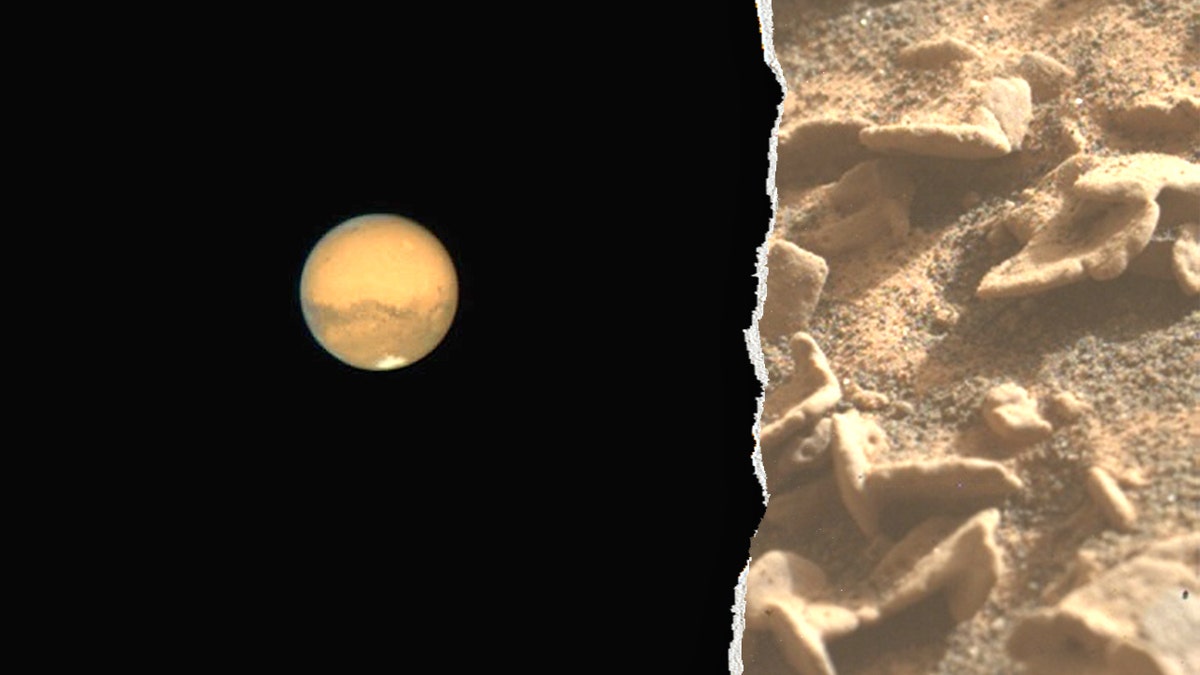
NASA scientists are examining peculiar formations on Mars, described as resembling potato chips. This investigation aims to understand how these shapes formed and what they are composed of. The news appeared in NASA’s ‘Curiosity’ blog on November 11.
The Curiosity rover, a NASA project exploring Mars since 2012, scrutinized these unusual formations during a recent drilling campaign at a site called ‘Nazca.’ The rover has been crucial in studying the planet’s surface.
‘This is an area characterized by bedrock containing disk-shaped (or, in a liberal interpretation, potato-chip shaped) crystal forms,’ said NASA in its blog.
The formations, embedded in the rock with irregular, curled shapes, some resembling potato chips, have attracted significant interest. The key objective is to better understand these features.
Samples from the Nazca drill site were analyzed using Curiosity’s Sample Analysis at Mars (SAM) instrument, which assesses their chemical makeup. The rover also employed its ChemCam instrument to study a crystal-shaped formation dubbed ‘Colca.’ This instrument uses lasers to reveal chemical compositions.
Additionally, NASA plans to utilize the Mars Hand Lens Imager (MAHLI), a camera on Curiosity’s robotic arm, to photograph the formations with white-light and ultraviolet LED lamps at night.
‘ChemCam LIBS observations were planned for each sol including a cluster of crystal forms, a resistant layer in the side of the Nazca block, and a dark float rock,’ the NASA blog added.
After examining the Nazca site, Curiosity will resume its exploration of Mars, continuing its southward trajectory. This site is among several being studied as scientists aim to learn about Mars and our solar system.
In a related event, astronomers recently discovered a potential dwarf planet beyond Pluto using the Vera C. Rubin Observatory in Chile. This object, named 2026 ED138, ranges from 370 to 930 miles in size, potentially placing it among the largest dwarf planets in our distant solar system.