
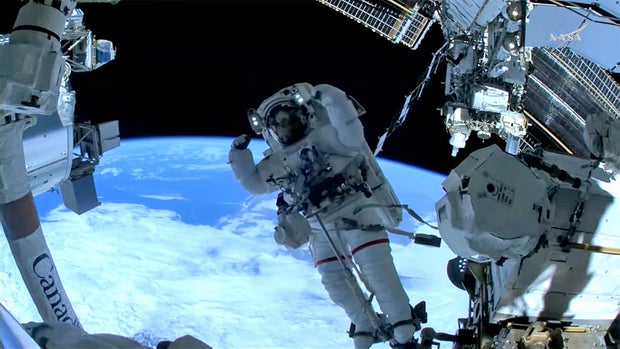
On a recent spacewalk outside the International Space Station (ISS), two NASA astronauts successfully replaced a failed 200-pound wrist joint on the station’s robotic arm. Canadian astronaut Jenni Gibbons, communicating from mission control, praised the astronauts’ meticulous efforts during the seven-hour and twenty-minute operation.
Issues with the robotic arm, known as Canadarm2, were flagged on May 27 by Houston’s Johnson Space Center. There were signs of abnormal power usage and improper movement in one of the seven joints. After thorough analysis, NASA and the Canadian Space Agency determined that the joint needed replacement.
The robotic arm was designed with maintenance in mind. Equipped with interchangeable parts, it allows astronauts to perform repairs like the one executed in this spacewalk. Bill Spetch, ISS operations and integration manager, emphasized the forward planning involved with such systems.
Astronauts Chris Williams and Jessica Meir participated in this operation. Beginning at 8:20 a.m. ET, the duo switched their spacesuits to battery power from within the Quest airlock. The spacewalk marked the year’s third such operation and the 280th overall for the ISS.
The astronauts worked efficiently, detaching parts and positioning the spare joint for successful installation. Chris Williams moved the failed wrist joint to temporary storage as they proceeded with the repair.
The task went as planned. The astronauts were able to install the new wrist joint four and a half hours into the spacewalk. Following this, they reattached the latching end effector (LEE) cluster, completing the major repair tasks.
“We heard good confirmation that Canadarm2 has two good strings of power and data to the arm,” NASA commentator Sandra Jones reported, indicating a successful outcome.
After completing their tasks, Williams and Meir headed back to the airlock, bringing the failed joint for potential refurbishing on Earth. The repaired joint may return to the ISS for future use.
The robotic arm plays a crucial role in station logistics. It captures Cygnus cargo ships, assists in docking, and supports astronauts during maintenance. Despite planned ISS retirement by 2030, NASA affirms ongoing arm maintenance due to its operational significance.
Spetch reiterated that maintaining the arm is imperative for the ISS’s functionalities until its end-of-life stage. He emphasized a commitment to repairs and upkeep essential to station activities and overall objectives.