
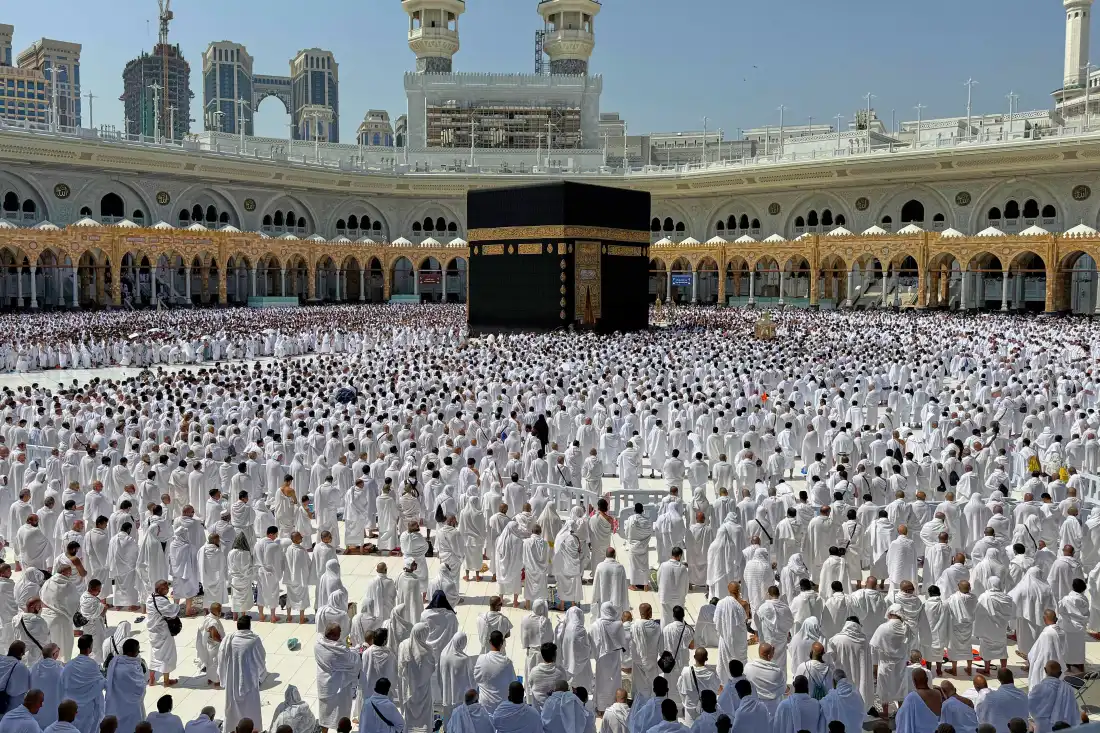
Devout Muslims gather and pray in front of the Kaaba, the most sacred site in Islam, located within the Grand Mosque in Mecca, Saudi Arabia. According to a new report released by the Pew Research Center, Muslims are projected to become the largest religious group globally by 2035, with Christians as the second-largest group.
Both the Muslim and Christian populations are predicted to grow, but researchers expect Muslims to increase at a faster pace. Based on current demographic trends, Pew forecasts the global Muslim population will reach 3.6 billion by 2070, surpassing the Christian population expected to be just under 3 billion.
The Pew Research Center formulated these projections using national census data worldwide, fertility rates, and patterns in religious switching. The analysis also incorporated findings from United Nations reports and global migration estimates, along with Pew’s earlier studies on religious migration.
Though Hindus and Jews are expected to expand in absolute numbers, their overall percentage within the global population will decrease. Conversely, Buddhists are anticipated to decrease both in numbers and as a portion of the global populace in coming decades.
Explaining Religious Shifts: Demographics and Fertility
Population growth trends significantly influence these religious shifts. Notably, much of the 21st-century population growth is expected to take place in Africa. By 2070, over a quarter of the world’s population is projected to reside in sub-Saharan Africa, where the majority identify as either Christian or Muslim. The high fertility rates and increasing lifespans in the region will contribute to the growth in numbers of both faiths, with the Muslim population expanding more rapidly.
In fact, Pew predicts that by 2070, the Democratic Republic of the Congo will surpass the United States in having the largest total number of Christians. Alan Cooperman, Pew’s director of religion research, describes this as a global shift in the perceived center of gravity for Christianity.
Birth Rates and Their Impact on Religions
Pew highlights how fertility rate differences significantly impact religious demographics. Around the world, Muslims generally have a higher number of children compared to those of other faiths. Currently, the fertility rate for Muslims is 3.1 children per woman, while non-Muslim women average about 2 children.
Among other religious trends by 2070 highlighted in the Pew report:
- China, Japan, and South Korea are all expected to see population declines, with their Buddhist populations shrinking by half.
- An increasing number of Jews worldwide will reside in Israel. Currently, 46% of the global Jewish population live there, but by 2070 that figure is projected to rise to 62%.
While globally the percentage of those identifying as religiously unaffiliated will rise in many countries, the overall population of “nones” is expected to decline. This is largely because a substantial portion of the religiously unaffiliated are in China, where significant population reductions are anticipated due to declining birth rates.
Religious Changes in the United States
The Pew report also outlines how religious shifts will impact the United States. By 2070, the U.S. is projected to lose its Christian majority, although Christians will remain the largest religious group, making up just under 48% of the population (down from 62% currently). Simultaneously, the proportion of those who are religiously unaffiliated is expected to grow to 41%.
The anticipated changes in the U.S. religious landscape will largely result from religious switching rather than birth rates. Christians have many leaving for no religious affiliation rather than joining another tradition. The country is expected to become more religiously diverse, with Muslims and Hindus projected to outnumber Jews by 2070 if current trends persist.