
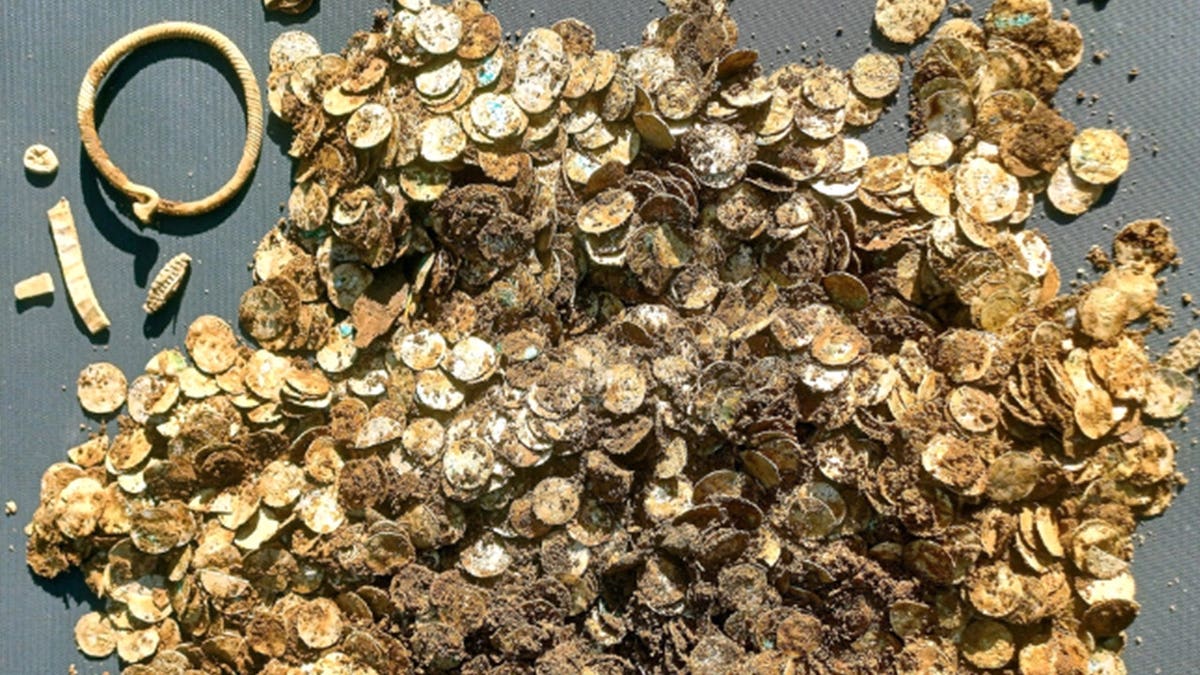
A metal detectorist in Finland made a significant archaeological discovery: a Viking Age silver hoard containing over 4,000 coins, marking the largest find of its kind in the country. This discovery was made by Kalle Lappinen near the village center of Sysmä, located approximately 105 miles northeast of Helsinki.
Lappinen found the hoard on September 3 and immediately notified authorities. Archaeologists from Lahti Museums started recovering the treasure the following day. It comprises thousands of silver coins, hack silver, a silver bracelet, a mount, and a bead, as stated in a museum release.
The coins from the hoard originate from present-day Sweden, Britain, and Germany, alongside dirhams from regions now part of Turkey and Iran. The coins, weighing around 10 pounds, are believed to date to between 1000 and 1050 A.D., according to Esko Tikkala, an archaeologist at Lahti Museums overseeing the recovery. Though the dating is preliminary, further cleaning and study will refine these estimates.
The find far exceeds previous discoveries in terms of size. Most hoards from the period contain tens or hundreds of coins, but this hoard held thousands, providing vital clues about Sysmä as a crucial hub during the Late Iron Age with broad trade connections. While today Sysmä may appear modest, the archaeological findings suggest it was once bustling with activity.
The hoard dwarfs Finland’s previously largest known Viking Age coin hoard, unearthed in Nousiainen in 1895, containing approximately 1,700 coins. The hoard’s owner’s identity is unknown, per Tikkala, who expressed several theories about why the silver was buried. One possibility is that a merchant buried wealth for safekeeping. Alternatively, a local inhabitant may have hidden assets due to military threats. Researchers still seek to unravel why the treasure remains unclaimed.
Frida Ehrnsten, keeper of numismatic collections at the National Museum of Finland, shared that the discovery might revamp researchers’ understanding of silver circulation in the region from 1,000 years ago, potentially altering perceptions of the Viking Age silver economy.
Ehrnsten highlighted that this era saw people living in Finland often not referred to as Vikings; rather, ‘Viking Age’ describes the broader cultural context. One intriguing element of the discovery is the silver’s presence in two separate deposits roughly 39 feet apart, forming a ‘double hoard,’ an unprecedented phenomenon in Finnish archaeology.
Hobbyists with metal detectors have significantly contributed to the surge in archaeological coin discoveries across Finland. About 25 years ago, Finland had around 7,000 known Viking Age coins. Today, they have doubled to roughly 14,000, thanks to these enthusiasts.