
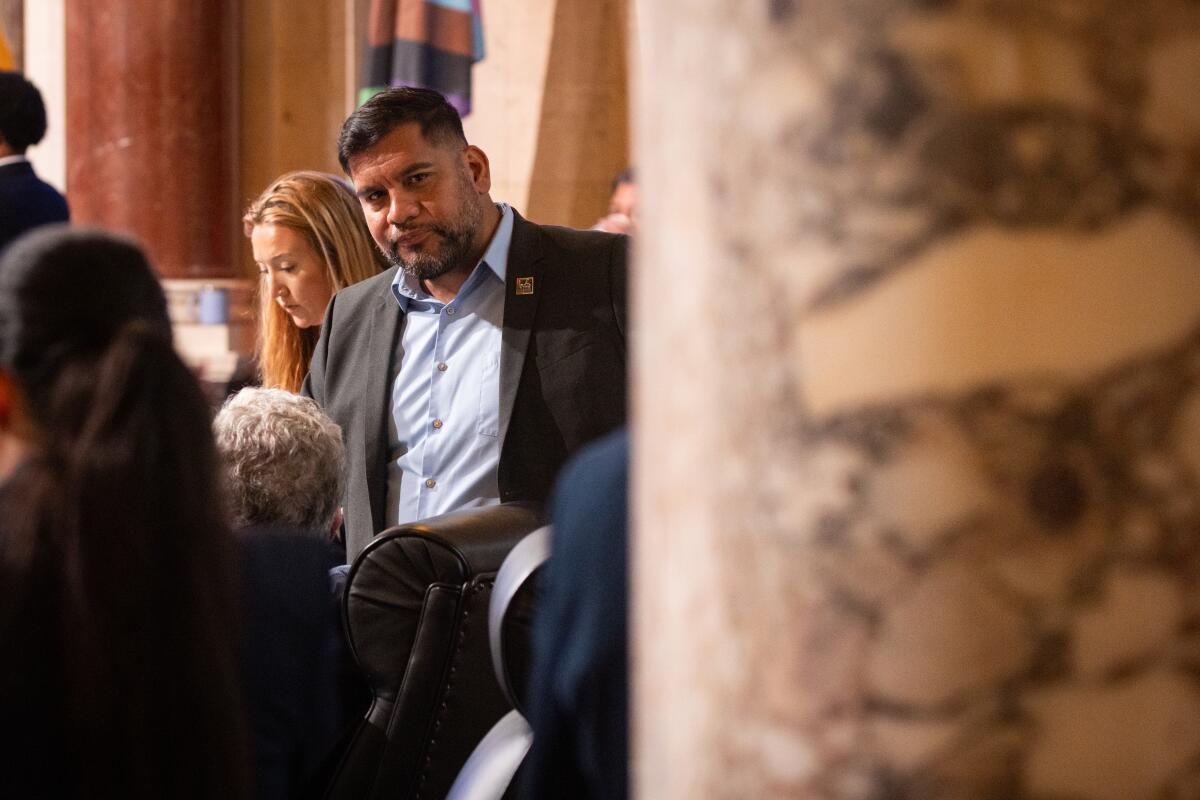
Southern California witnessed federal immigration agents apprehending undocumented workers from various locations, such as car washes, garment factories, and parking lots. Angelica Salas, leading a significant immigrant rights group, regularly met with City Councilmember Hugo Soto-Martínez, whose parents are Mexican immigrants, to address the situation. Their discussions highlighted the lack of political influence wielded by noncitizens.
“Immigrants don’t have the right to vote,” said Salas, executive director of the Coalition for Humane Immigrant Rights. This issue inspired Soto-Martínez in April to propose a ballot measure that would allow noncitizens to vote in city and school district elections. The proposal gained traction, with two-thirds of the council voting in June to draft a measure for the November ballot.
However, the initiative faltered, with the council deciding to send it for further study rather than moving forward. Soto-Martínez admitted he had not sufficiently reached out to Black community leaders. Critics argued the council left too many questions unanswered, such as whether undocumented immigrants would be included. Some feared this could make vulnerable populations new targets for the Trump administration.
Mobilizing Preachers and Communities, a national nonprofit, called for a delay due to these concerns. Rev. K.W. Tulloss cited worries from Black residents that the measure might reduce Black voting power, affecting the election of Black officials in Los Angeles.
In Los Angeles, Black residents represent about 8% of registered voters, a number that has been in decline. Noncitizen voters could further diminish this percentage. By year-end, Los Angeles City Council will have two Black members, down from three, all from districts in South L.A.
Rev. Tulloss’s organization supports a citizenship pathway for undocumented immigrants but fears short-term divisions between Black and brown residents. Soto-Martínez, representing a district from Echo Park to Hollywood, said noncitizen voting was part of his platform. He recalled San Francisco’s decision allowing noncitizen parents to vote in school board elections.
Noncitizen voting discussions have long been present in L.A. School board member Kelly Gonez sparked interest in 2019, but efforts slowed with the COVID-19 pandemic. In March, a citizens commission debated the idea but narrowly rejected it due to concerns about unintended fallout from the Trump administration.
Soto-Martínez later proposed expanding voting rights through a two-step process, initially asking voters to empower the City Council to grant voting rights to noncitizens. This would be followed by detailed examination before passing an ordinance.
Critics, including former Mayor Antonio Villaraigosa, argue now is not the time for noncitizen voting. They fear exposure to deportation amid federal scrutiny.
Soto-Martínez dismissed these fears as “fear mongering,” stating undocumented immigrants already face risks in daily life. Salas echoed his sentiments, noting immigrants are already targets.
The proposal’s hesitancy also stems from practical concerns. Councilmember Monica Rodriguez noted the need to determine logistical issues, such as issuing distinct ballots for different contests and calculating the cost. Megan Dias, co-author of a report on immigrant voting in San Francisco, emphasized building a broad coalition before presenting noncitizen voting to voters.
Council President Marqueece Harris-Dawson expressed confidence in a more comprehensive review, aiming for a 2028 ballot. The council must clearly outline how these changes will work and ensure the protection of Black voting districts.