
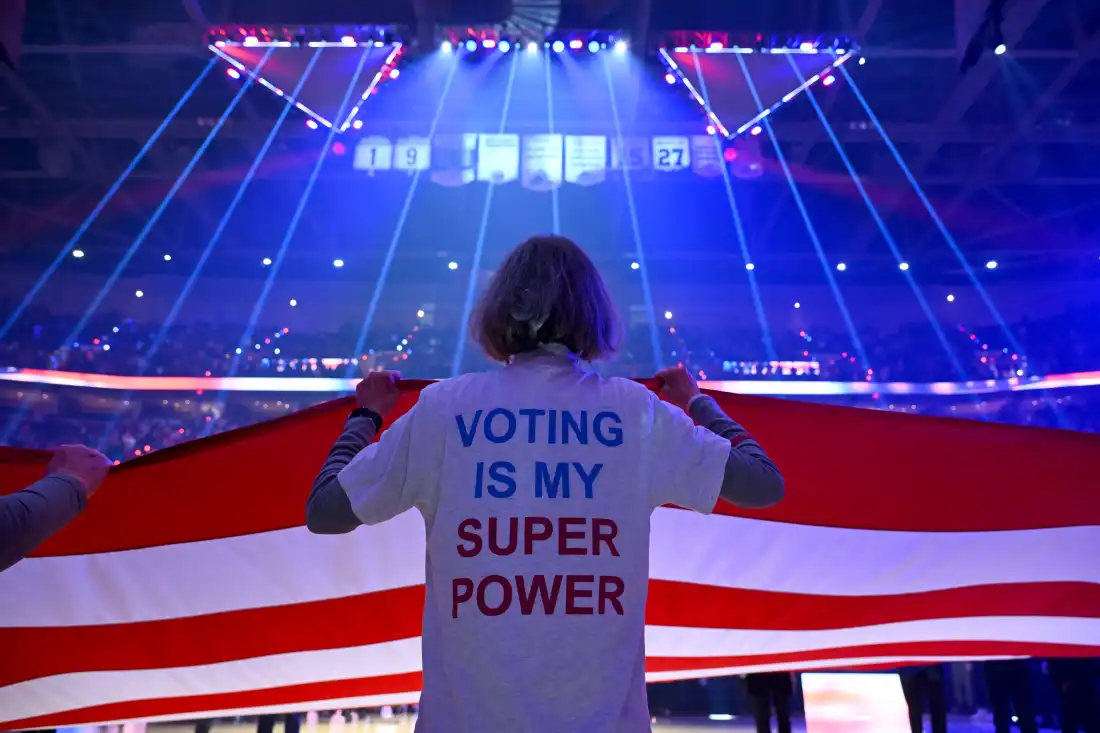
A representative from the League of Women Voters of Greater Cleveland held the flag during the national anthem at a basketball game in Cleveland, Ohio, on October 26, 2026. At the same time, new poll data reveals the political climate leading up to the midterm elections.
A recent NPR/PBS News/Marist poll indicates that Democrats maintain strong midterm advantages, with data suggesting they are favorites to win U.S. House control. However, possible limits to a Democratic wave are observed. This poll also outlines key issues influencing voters.
Voter Concerns: Economy and Democracy
The economy emerges as a critical concern, with one-third of respondents reporting financial hardships over the past year, and 40% stating their finances have worsened. Shun Maurice from Arizona, an independent leaning Democrat, emphasizes the impact of high food and gas prices.
Democrats and independents emphasize preserving democracy, while MAGA supporters prioritize immigration concerns. The survey of 1,289 registered voters was conducted from October 19-20, with a margin of error for registered voters at +/- 3.7 points and for likely voters at +/- 3.8 points.
Approval Ratings and Congressional Preferences
President Trump’s disapproval remains high; 61% of registered voters disapprove, while 53% strongly disapprove. Among likely voters, Trump’s disapproval is slightly lower. Trump’s favorability stands at 37% among likely voters.
Democrats enjoy a lead on the congressional ballot. Among registered voters, Democrats have a 10-point advantage. With likely voters, the lead narrows to 8 points. Historically, such a lead has resulted in the Democratic Party gaining the House.
Redistricting Impacts and Voter Sentiment
The 2020 Census and subsequent redistricting have favored Republicans. This structural shift has heightened Democratic nervousness despite retaining a likely voter edge. Only 81% of Democratic likely voters are confident about a Democratic win.
Likely voters prioritize new ideas and change. About 55% of likely voters prefer candidates who offer fresh perspectives. Chris Agan from Texas supports Democrat James Talarico, viewing him as a candidate of change.
Trump’s Influence and Swing Voter Concerns
Although Trump is not on the ballot, his influence persists. Many likely voters indicate their votes are against Trump, not for him. Yet, Trump’s unpopularity does not guarantee increased Democratic support.
Some swing voters express disapproval of the Democratic Party’s lean towards democratic socialism. Matthew Schroder from Charlotte, NC, opposes this trend and supports Republican candidates.
Enthusiasm Gap and Key Demographic Trends
Democrats lead with likely voter enthusiasm. Still, some Democratic constituents exhibit lower enthusiasm levels, such as younger, non-white, and white women with college degrees demographics. Comparatively, pro-Trump groups remain enthusiastic.
The gap between Democrats and Republicans in election close monitoring has narrowed. Enthusiasm levels may impact turnout, especially among motivated Democratic bases.
Trust in Election Integrity
Three-quarters of likely voters trust their state and local governments to conduct fair and accurate elections. MAGA supporters are less convinced compared to other groups.
Overall, 70% of Republicans agree their candidate should accept election results, though some support challenging them. Differences persist between democratic socialists and MAGA supporters on election result acceptance.
Central Issues in the Election
- Personal Finances: 38% report deteriorating personal finances. Younger generations face more financial hardships.
- Artificial Intelligence: Public opinion challenges persist, with many opposing new data center construction.
- Immigration: The majority support a legal pathway for immigrants, but Republicans generally favor removal.
- Government Efficiency: Differing perspectives on government effectiveness, with clear partisan divides.
- Gun Laws: Voter opinions are nearly evenly split between stricter gun control and gun rights.
- Equality: 70% support equality across all groups, with more division among Republicans.
Methodology: The NPR/PBS News/Marist Poll surveyed 1,289 registered voters via phone, text, or online. The margin of error for registered voters is +/- 3.7 percentage points; for likely voters, it is +/- 3.8 points.