
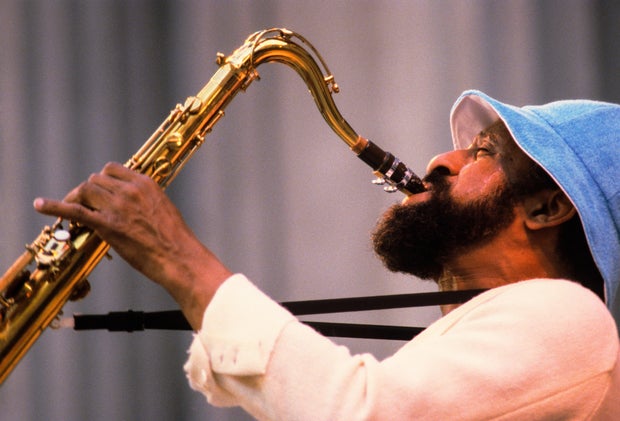
On May 25, 2026, Sonny Rollins, the innovative tenor saxophonist who transformed jazz with his bold sound and unrelenting experimentation, passed away at 95. His spokesperson, Terri Hinte, confirmed that he died at his residence in Woodstock, New York. While Hinte did not specify the cause of death, she noted that Rollins had faced several health challenges in recent years, limiting his mobility.
From his remarkable beginnings as a teenage talent to his evolution as a solo artist and pioneering role in free jazz, Rollins was celebrated for his unmatched improvisational prowess. Alongside contemporaries like John Coltrane and Charlie Parker, he stood as one of the most influential figures of the bebop era. Rollins crossed into rock music when his sax solo appeared on the Rolling Stones’ 1981 album “Tattoo You,” in the track “Waiting on a Friend.”
Despite his lasting success, Rollins felt a constant need to evolve his art. He often spoke of himself as “a work in progress,” embracing varied musical styles throughout his career. He expressed discomfort with his past recordings, finding it “excruciating” to hear the perceived flaws.
By the 1990s and 2000s, Rollins released numerous acclaimed albums. His dedication to music was unwavering, maintaining a strict practice schedule and performing into his 80s. However, pulmonary fibrosis affected his ability to play, leading to his retirement in 2014. He reflected fondly on the joy of playing, recalling the connection he felt during open-air performances.
Rollins’s album “This is What I Do” earned him a Grammy for Best Jazz Instrumental Album in 2001. He won another Grammy in 2006 for his solo in “Why Was I Born?” from the album “Without a Song: The 9/11 Concert,” recorded shortly after the September 11 attacks. Encouraged by his wife, Lucille, to proceed with the performance despite the recent tragedy, he found solace and insight into life’s challenges.
Born Theodore Walter Rollins on September 7, 1930, in Harlem, music surrounded him from an early age. His family was musically inclined, with his father playing the clarinet and his siblings taking up the piano and violin. He developed an affinity for the saxophone, convincing his parents to purchase an alto sax when he was 11.
Rollins’s career accelerated when he joined Thelonious Monk’s band as a teenager. He soon interacted with legends like Miles Davis and Bud Powell, breaking into the recording scene. Despite a period of addiction to heroin in the late 1940s and early 1950s, Rollins emerged clean after treatment, reaffirming his commitment to music with new philosophical insights into life.
In the mid-1950s, Rollins collaborated with the Max Roach-Clifford Brown quintet and released the influential album “Saxophone Colossus.” He later ventured into different formats, such as pianoless trios, delivering more landmark records. After a period of seclusion, he returned to a changed jazz landscape, embracing the new free jazz style.
His exposure to Zen Buddhism while in Japan inspired a sabbatical during the 1970s. When he resumed recording in 1972, Rollins received widespread acclaim and recognition, including a Guggenheim fellowship and induction into the DownBeat Hall of Fame.
A celebrated figure, Rollins was honored at the Kennedy Center in 2011. Although he left many recordings unreleased, he expressed no concern about their future once he departed. “After I get out of this planet, I’m not going to have any say about what’s going on,” he told the New York Times in 2020, grateful for escaping the pressure of his musical agonies.
Sonny Rollins is survived by his nephew and nieces, leaving behind a profound legacy in the world of jazz.