
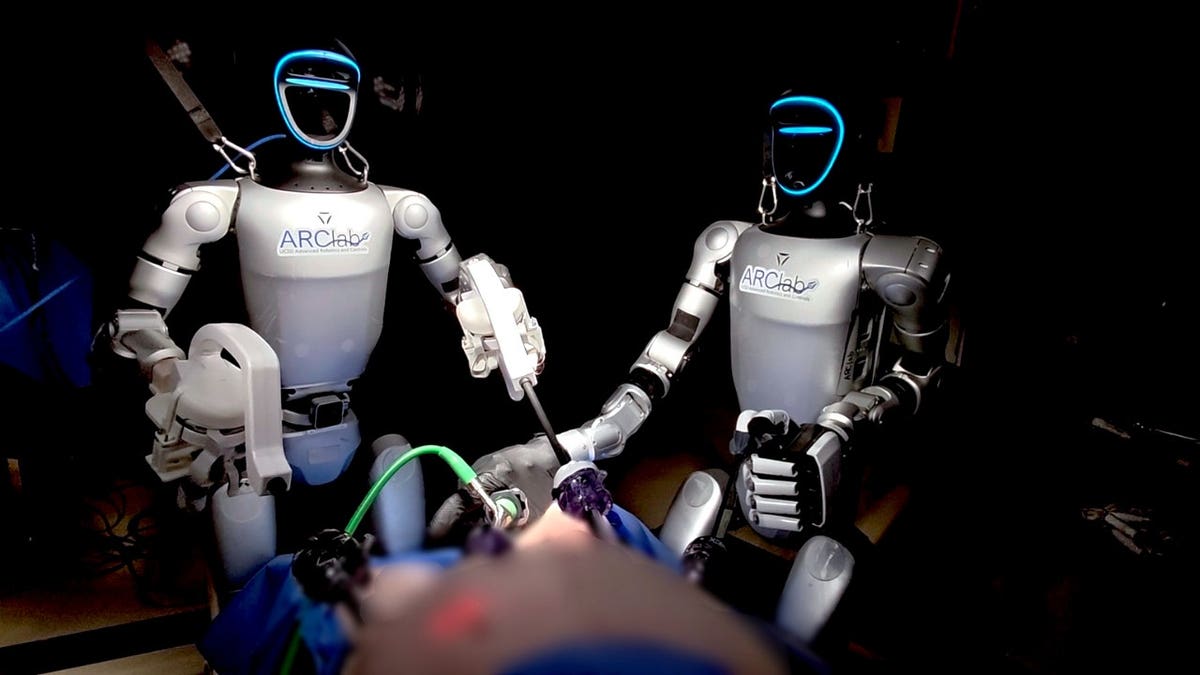
A team from UC San Diego made a significant medical breakthrough by successfully using humanoid robots for remote gallbladder surgery on a pig. This milestone underscores artificial intelligence’s potential to alleviate surgeon shortages and enhance global healthcare access.
Two humanoid robots were used to perform these surgeries, marking a pivotal moment in medical robotics. The robots mimicked the surgeons’ movements, with no human patients involved. Unlike stationary robotic systems, these mobile machines operate in regular surgical rooms using standard tools, showcasing how specialists might soon conduct surgeries in remote areas.
First Steps in Robotic-Assisted Surgery
UC San Diego researchers published their findings in the journal Nature. They conducted two laparoscopic procedures on pigs, a trial designed to test if general-purpose robots can manage typical surgical tasks. The robots demonstrated capabilities such as moving tissue and applying clips, although significant improvements are necessary before human trials can be considered.
This marks the first instance of teleoperated humanoid robots completing live gallbladder surgeries, building on previous research where similar robots performed various medical tasks. The goal is ultimately to broaden access to crucial surgical procedures.
The Advantage of Humanoid Robots
Modern surgical systems are often large and space-consuming. In contrast, humanoid robots like the Surgie model are smaller and more flexible. They can fit in standard operating rooms, are more affordable than current systems, and have the potential to bring surgical expertise to remote areas.
These robots use adapted hand tools, controlled remotely by surgeons. This approach allows for the deployment in existing medical settings without extensive room modifications. However, many challenges remain, including ensuring reliable and speedy operation without latency issues.
Challenges and Future Prospects
The trial highlighted several areas for improvement, such as reducing operation time and addressing connectivity delays. Researchers aim to refine these systems to ensure consistent performance, reliability, and safety before progressing to human trials.
Questions remain about the implications of autonomous robots in medicine, particularly around decision-making and accountability. Security and communication integrity are also critical factors, especially when operating remotely.
These developments prompt a discussion on the role of robots in surgery and whether they could eventually conduct procedures entirely on their own. For now, human oversight remains essential, especially considering the unpredictability of live human surgery.
While humanoid robots won’t replace surgeons in the immediate future, this technology represents an important step toward enhancing healthcare access. Its success could lead to a transformative era in medical practice, reducing travel requirements for patients and expanding the reach of specialized surgical care.