
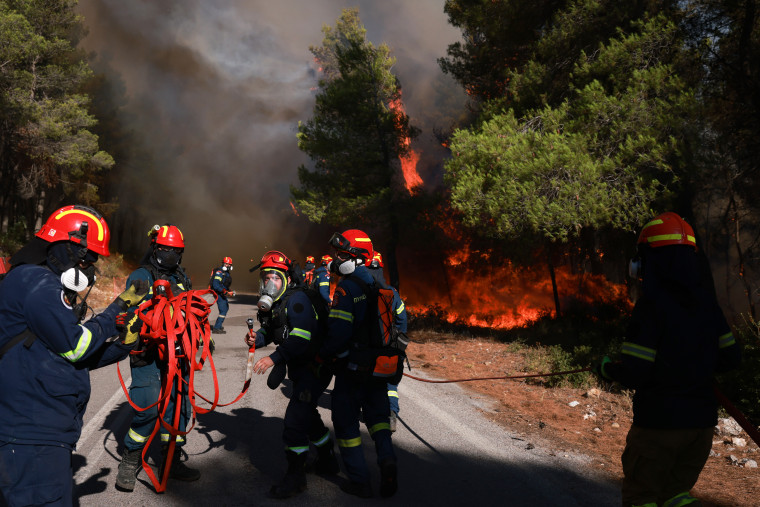
Greek firefighters engaged in relentless efforts on Sunday to contain a massive wildfire that razed over 100 homes northwest of Athens. Simultaneously, another fire prompted evacuations on the tourist-favored island of Kefalonia.
This summer, Europe faced devastating wildfires, fueled by unprecedented heatwaves and scant rainfall. Scientists attribute these extreme conditions to climate change. In France and Spain, fires began to ease over the weekend. Greece, after a brief respite, saw several new fires.
In the region around Porto Germeno, near the Gulf of Corinth, the wind-driven fire had crossed a mountain and reached the settlement of Veniza, also threatening a military firing range with unexploded ordnance. Nearly 500 Greek firefighters, supported by resources from France and Romania, battled the flames with vehicles, heavy machinery, and aircraft.
The fire has been burning since last night, it is certain that they cannot have forces everywhere. We as residents are doing everything we can,said Tasos Tzempelikos, a local resident, as he aided with efforts to stop the fire’s spread.
Efforts concentrated on preventing the blaze from reaching the coastal town of Megara, as over 38 square miles of land had likely been destroyed. Meanwhile, evacuations took place overnight on Kefalonia’s Pastra area due to another outbreak.
Elsewhere in Europe, France reported minor flare-ups as fires in Gironde and Var eased. In central Spain, fires that devastated tens of thousands of hectares were mostly under control, though some areas experienced re-ignitions.
In the western Spanish province of Caceres, a fire erupted on Saturday. Around 800 residents evacuated but were allowed to return on Sunday with restrictions still in place.
Access to key rivers like the Rhine and Danube has deteriorated due to drought in several European countries. Hungary’s Danube levels hit a historic low, compelling the shutdown of its only nuclear power plant for the first time in over 40 years, as another heatwave threatens the region.
Water transport and tourism in Hungary stalled, and over 100 cities and villages imposed water-use restrictions. Serbia’s Danube levels plunged to their lowest since 1985, reducing output from the country’s largest hydropower plant to 20%, the energy minister reported.