
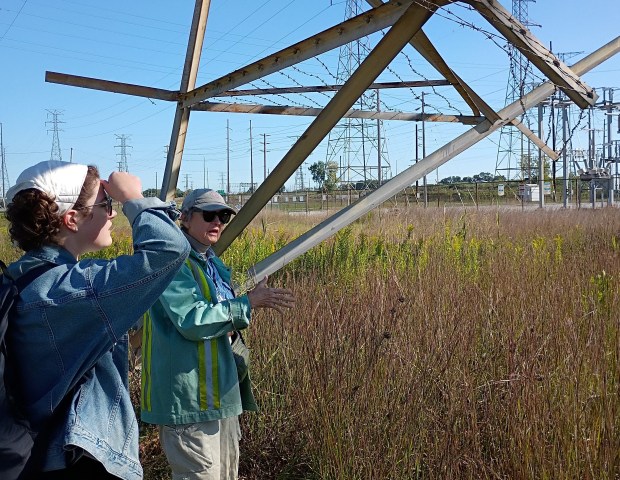
Transmission towers and high-voltage power lines stretch over the Eggers Grove Cook County Forest Preserve on Chicago’s Southeast Side, near 118th Street and the Illinois/Indiana border. On the ground, cyclists and hikers pass by prairie plants and native grasses heavy with early fall seed, including little blue stem, yellow prairie grass, goldenrod, and whorled milkweed. Monarch butterflies flutter around, landing on flowers as they migrate south. This natural landscape is one of 53 sites in northern Illinois where ComEd has implemented land management practices to aid the monarchs.
Despite many butterflies having already left for central Mexico, ComEd’s efforts indicate a broader initiative to transform right-of-way areas into supportive habitats. “Whether you’re talking about a pocket garden in someone’s backyard or right-of-way, any space with a supportive pollinator habitat is important for species survival,” said Catherine O’Reilly, partner coordinator for the Sustainable Landscapes at the Energy Resources Center at the University of Illinois Chicago’s College of Engineering.
Six years ago, around 40 energy and transportation organizations developed the Nationwide Candidate Conservation Agreement with Assurances for Monarch Butterfly on Energy and Transportation Lands, or “Monarch CCAA.” Valid through 2045, the agreement encourages right-of-way landowners and managers to implement conservation to support the monarch. “This effort has gotten a lot of buy-in,” said O’Reilly, facilitative for the Rights-of-Way as Habitat Working Group. “Total enrolled lands include 9.3 million acres, with more than 1.3 million acres adopted as habitat.”
Catherine O’Reilly checks a right-of-way area with Mary Kozlowski, volunteer steward for the Eggers Grove Cook County Forest Preserve. (Susan DeGrane/Daily Southtown)
In Illinois, which designates the Monarch as the state insect, right-of-way commitments from energy utilities and transportation agencies have led to a resurgence of milkweed, the monarch’s host plant. From 2014 through 2024, stem counts for milkweed increased by 108 million, as reported by a UIC Sustainable Landscapes report submitted to the Illinois Department of Natural Resources. Half of these increases occurred in right-of-way spaces.
O’Reilly mentioned that rights-of-way often support pollinator and prairie habitats because they manage tree growth. The Monarch CCAA uses this advantage to ensure specific practices like reducing mowing, planting native species, controlling invasive plants, and using controlled burning and grazing. ComEd does all these, including controlled burning, which needs trained professionals and permits.
“CCAAs are legally binding and suggest measures beyond compliance,” said Sara Race, ComEd’s senior manager of Environmental Management. ComEd’s agreement helps pollinators while allowing continued operations if a species becomes endangered, Race added. Their commitment promotes community engagement and goodwill. Volunteer site steward Marianne Kozłowski leads teams removing invasive plants and gathering seeds within the Forest Preserve, clearing trash in solidarity with a Friends of the Chicago River cleanup effort.
Power lines cut through a natural area near Eggers Grove Cook County Forest Preserve. (Susan DeGrane/Daily Southtown)
In other areas like LaSalle and DuPage counties, ComEd encourages fourth graders through the Mighty Acorns program to plant milkweed and remove invasive species in designated right-of-way areas. In 2020, the Illinois Department of Transportation pledged 401,000 acres for right-of-way to support the monarchs. IDOT reduces mowing, applies targeted herbicides, and sows native plants in these areas.
Just south of Champaign, IDOT removed invasive shrubs and planted purple coneflower, bee balm, and milkweed. “Our number one priority is safe travel, so we have to maintain visual lines,” said James Schackmann, IDOT’s roadside maintenance specialist. Although IDOT cannot stop mowing entirely, they preserve species-sensitive areas and claim 5,300 acres of native roadside prairie. Schackmann noted that non-native plants can block drains and cause issues, highlighting the benefits of IDOT’s initiatives.
A late-season monarch caterpillar feeds on milkweed in Chicago’s Beverly neighborhood. (Susan DeGrane/Daily Southtown)
Though exact cost savings are unclear, less mowing reduces safety risks associated with equipment and roadside navigation. “While returning the prairie to its original state isn’t feasible, we’re maintaining a modern prairie that performs essential functions,” Schackmann said. These spaces absorb runoff, sequester carbon, and provide a visually pleasing landscape.
Susan DeGrane is a freelance reporter for the Daily Southtown.