
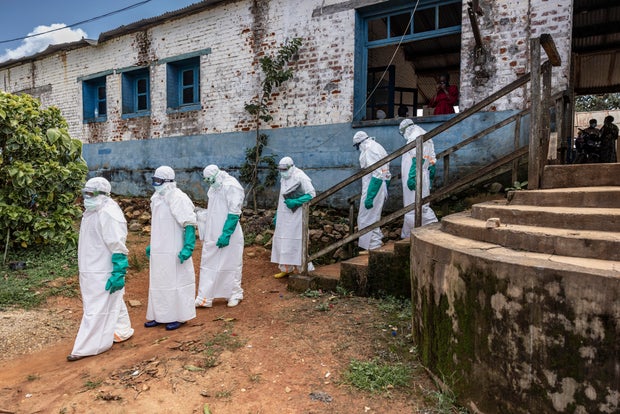
The World Health Organization (WHO) has reported at least 220 suspected deaths due to the ongoing Ebola outbreak, according to Reuters. WHO Director-General Tedros Adhanom Ghebreyesus highlighted that a delay in detecting cases has led to health workers trying to catch up in controlling the spread.
In Uganda, health authorities have confirmed two new Ebola cases, bringing their total to seven. These cases are connected to the outbreak in the neighboring Democratic Republic of the Congo (DRC), where suspected cases have exceeded 900.
In early May, a 59-year-old man from Congo was admitted to a Kampala hospital and passed away three days later before being confirmed to have Ebola. Subsequently, two other Congolese nationals tested positive for the virus after seeking medical care in Uganda.

Ugandan officials confirmed two local infections on Saturday involving a driver and a health worker who had contact with the deceased patient from May 11. Subsequently, two additional health workers in Kampala tested positive, as reported by the Ministry of Health.
In Congo, the bulk of suspected cases are located in the eastern Ituri province, where confirmed cases have topped 100. The outbreak response is challenged by community resistance, including attacks on treatment centers, and distrust in authorities in a region with ongoing armed conflict. WHO has classified the outbreak as a public health emergency of international concern.
The Bundibugyo strain causing this outbreak currently has no approved vaccine or treatment. However, a vaccine is under development by University of Oxford scientists, with trials expected in a few months, as a WHO spokesperson informed BBC News.
Violence and Evacuations
Violence has further complicated containment efforts. On Sunday, young men attacked Mongbwalu General Hospital in eastern Congo, demanding the release of two deceased relatives, as staff hurriedly evacuated patients amid gunfire.
Dr. Richard Lokudu, the hospital’s medical director, confirmed that Mongbwalu General Hospital remains on high alert, though details of the incident remain scarce.
This attack marks the third assault on healthcare facilities within a week, underscoring the challenges medical workers face, including limited resources. Handling Ebola victim bodies is risky and fuels virus spread, prompting authorities to oversee such burials. This mandate often meets resistance from grieving communities.
On Friday, Congolese officials banned funerals and gatherings exceeding 50 people in northeastern Congo to curb the virus’s spread. Meanwhile, health screenings at the Uganda-DRC border were intensified following increased Ebola cases in Mpondwe, Uganda, depicted in images captured by Nicholas Kajoba for Anadolu via Getty Images.
Saturday, Mongbwalu residents attacked and burned a Doctors Without Borders tent for Ebola cases, leading to the disappearance of 18 suspected patients. Days earlier, a Rwampara treatment center faced destruction during familial attempts to recover a deceased relative.
WHO upgraded the outbreak’s Congo risk level to “very high” but maintained a low global spread risk. However, the Congolese Ministry of Communication noted discrepancies in death counts, listing 119 while regional reports total 220.
The outbreak’s timeline may alter if the International Federation of Red Cross and Red Crescent Societies’ statement is confirmed. They reported three volunteer fatalities contracting the virus while handling corpses on March 27.