
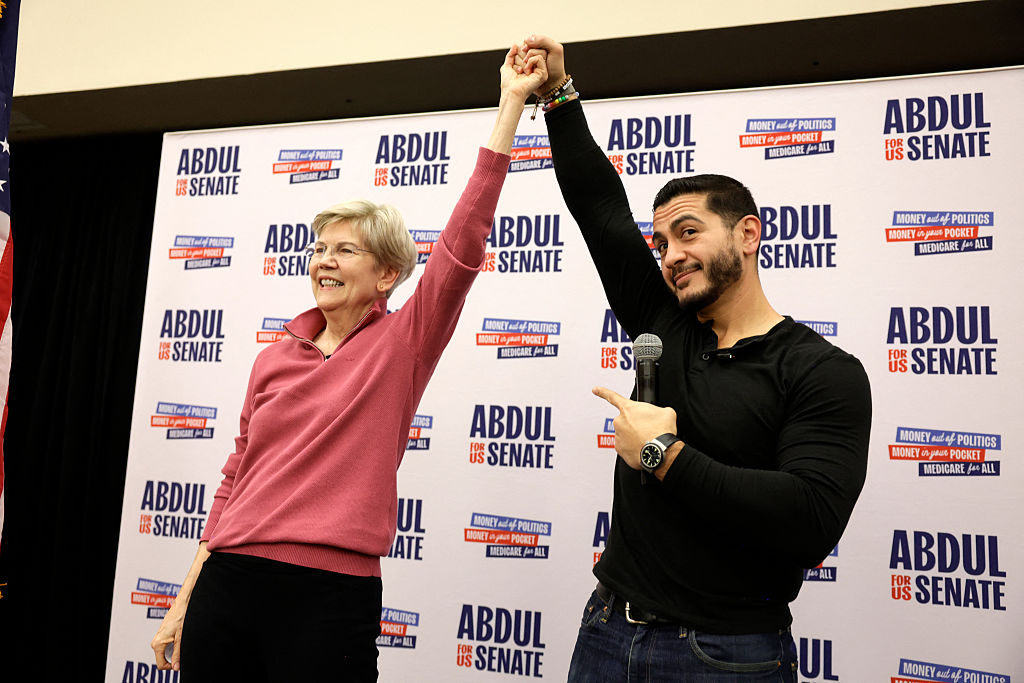
Dr. Abdul El-Sayed, a progressive Democrat with a strong background in public health, secured a significant victory by defeating former Representative Mike Rogers in Michigan’s open Senate race. According to The Associated Press, El-Sayed’s win marks the first time a Muslim has been elected to the United States Senate. This victory keeps the seat under Democratic control, blocking a prime opportunity for Republicans to counter the Democratic momentum observed in this year’s midterm elections. The retirement of Senator Gary Peters, a Democrat, set the stage for one of the nation’s most competitive Senate races in a key battleground state that former President Trump won by two points in 2024.
El-Sayed, 42, is the son of Egyptian immigrants and grew up in suburban Detroit. His election not only represents a milestone in American politics but also signals a potential shift within the Democratic Party. As an outspoken critic of Israel, he campaigned on a progressive platform and joins a growing group of left-wing Democrats succeeding in recent elections. Unlike progressive wins in safely Democratic areas, El-Sayed triumphed in a closely contested statewide race where both parties vie for the support of diverse constituencies, including working-class voters, suburban moderates, and an evolving electorate.
His campaign challenges the narrative held by some moderate Democrats that progressive candidates are too risky in battleground states. Despite a challenging campaign that exposed deep divisions among Democrats over issues like Israel and prompted significant spending from pro-Israel groups, El-Sayed prevailed. Notably, he experienced a rift with Haley Stevens, a former primary opponent, who endorsed Rogers shortly before the election.
A campaign marked by personal attacks
In its final weeks, the campaign turned notably bitter, with prominent Republicans, including Trump, employing Islamophobic stereotypes to portray El-Sayed as a national security threat. He faced severe criticism for campaigning with Hasan Piker, a controversial figure known for anti-U.S. remarks. Some Jewish voters accused El-Sayed of using antisemitic rhetoric in his criticism of Israel and reductions in U.S. military aid, which he argued compromised domestic priorities. El-Sayed has contested these allegations, stating his criticisms of the Israeli government are distinct from animosity towards Jewish individuals. These tensions reverberated through Michigan’s substantial Muslim and Jewish communities, transforming an election fraught with national implications into a deeply personal and challenging contest.
Trump, during a Michigan rally nine days before the election, baselessly labeled El-Sayed as affiliated with the Muslim Brotherhood, warning of potential terrorist threats. Trump repeatedly referred to El-Sayed using his middle name, Mohamed, which critics saw as a derogatory tactic. On the night before the election, Trump posted inflammatory remarks on Truth Social, exacerbating El-Sayed’s status as a target for Republican narratives this election cycle. Rogers, a former House Intelligence Committee chair, contributed to these unfounded allegations. El-Sayed has consistently denied any links to the Muslim Brotherhood.
For El-Sayed, these attacks echo earlier doubts he faced before his political career. In a 2007 TIME interview, Bill Clinton encouraged El-Sayed to consider public office after a speech at the University of Michigan, a notion El-Sayed found laughable given his name. Nearly two decades later, he has overcome those doubts, achieving a historic victory in a state where Muslim political influence has significantly increased. El-Sayed’s unique path to the Senate includes an education at the University of Michigan and Columbia University, although he did not practice medicine. Instead, he took roles in public health leadership in Detroit and Wayne County and ran, though unsuccessfully, for governor in 2018, earning comparisons to Barack Obama for his oratory skills.
El-Sayed’s campaign focused on opposing Trump, whose approval rating in Michigan had drastically fallen. A New York Times/Siena University poll in September showed only 34% of likely voters supported the President. El-Sayed stressed to Michigan voters that Trump was figuratively on the ballot, suggesting a vote against Rogers was synonymous with a vote against Trump. Rogers attempted to distance himself from Trump on more controversial issues in Michigan, like Canadian tariffs and war with Iran, but struggled to escape the broader negative sentiment towards Trump.
A progressive platform and divisions over Israel
El-Sayed campaigned on an extensive progressive agenda that included Medicare for All, increased taxes on the wealthy, and reducing corporate influence in politics. He linked rising living costs with the sway of wealthy donors over political decisions. As a vocal critic of Israel, his election comes in a region with significant Muslim and Jewish populations, both influential in Democratic politics but experiencing recent years differently post-2023 conflicts. The conflict over Israeli policies remained a divisive issue within the Democratic coalition, impacting the 2024 election when Trump won Michigan and shaping subsequent political landscapes.
El-Sayed’s stance on the Israel-Gaza conflict as genocide put him at odds with the Democratic establishment, facing opposition from groups like AIPAC who spent heavily against him. His campaign rhetoric led to concerns among some Jewish Democrats who felt his language created an unfriendly atmosphere, particularly after a synagogue attack in March. Although he condemned the violence, his comments about the attacker’s possible motivations stirred controversy, leading to his eventual apology.
A Democratic rift over Israel became evident after El-Sayed’s primary win over Stevens. They attempted to present a united front but ultimately failed as tensions over Israel persisted. Stevens’ last-minute endorsement of Rogers signaled a considerable defection in a pivotal race, showing the challenge El-Sayed faced in uniting a divided party facing internal disagreements over foreign policy, economic issues, and those related to influential donors.
The outcome raises questions about the Democratic Party’s ability to accommodate emerging progressive voices that challenge long-standing positions. As the party continues to evaluate its strategy and its approach towards former President Trump, El-Sayed’s success may shape ongoing debates about the future direction of the Democratic Party.