
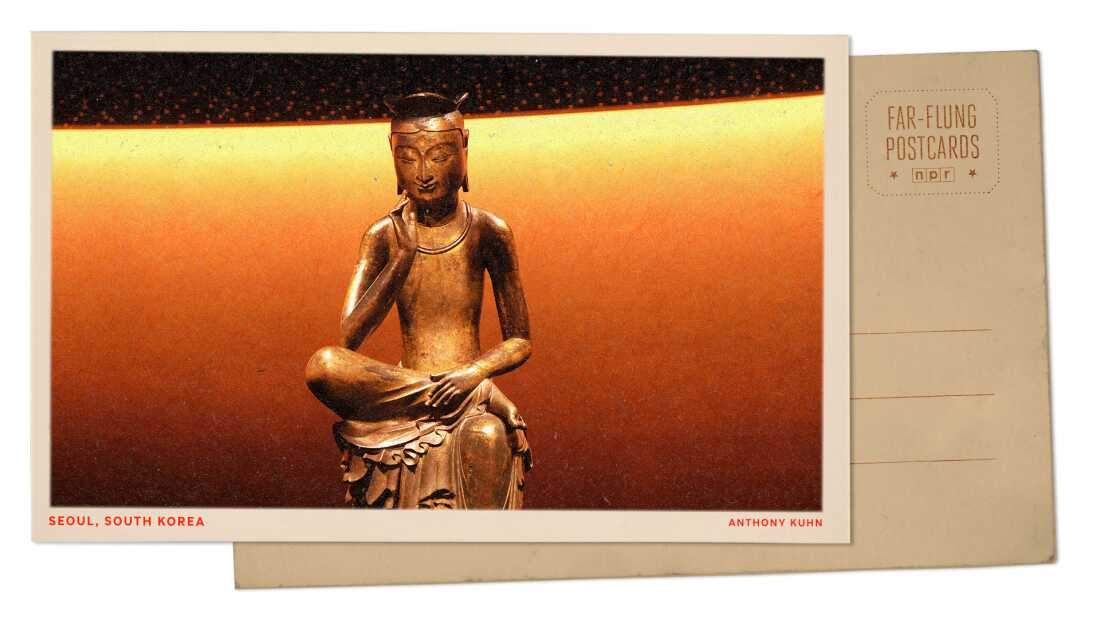
The National Museum of Korea, located near bamboo groves and pagodas, hosts some of the country’s most prized artworks. Inside the Room of Quiet Contemplation, two ancient bodhisattva statues attract attention. One dates back to the early seventh century, while the other originates from the sixth century. Both statues rest on a circular platform in a softly lit room accompanied by ambient sounds that suggest deep outer or inner space.
The statues showcase elegant simplicity with their graceful outlines and intricate drapery. Their eyes are half-closed, and a gentle smile graces their faces. Two fingers rest on their right cheeks. Their right legs are folded, and their left legs extend toward the ground. This positioning reflects deep meditation on life’s impermanence. Experts in Buddhism and Buddhist art assert that the statues’ smiles convey an understanding of truth, while the leg positioning indicates readiness for action to liberate sentient beings.
Visitors can hear a unique interpretation by scanning a code. Blackpink’s Jisoo offers insights, saying, “This Buddhist statue captures the aspirations of people who sought salvation through quiet reflection and enlightenment during a turbulent era filled with change and anxiety. That is why, even to this day, it holds the power to naturally soothe and calm the minds of those who look upon it.”
Through the incorporation of South Korean pop culture and innovative display techniques, the museum’s popularity soared. It ranked as the third-most visited museum globally last year, coming after the Louvre in Paris and the Vatican Museums.