
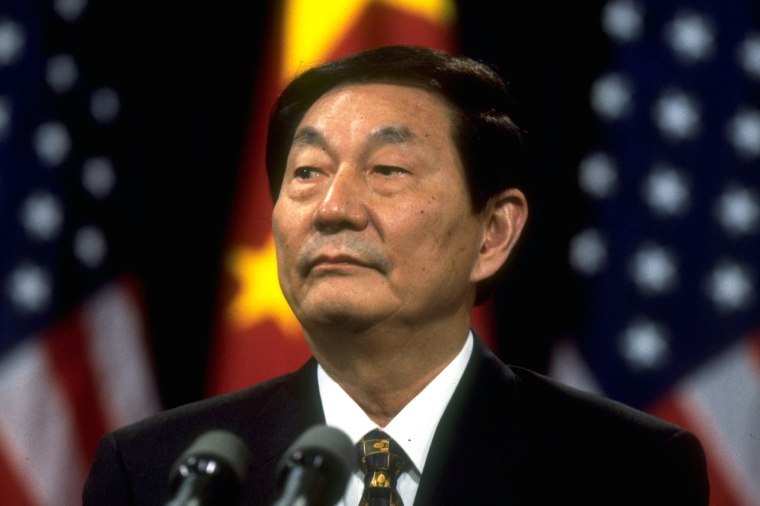
In Beijing, China consigned the body of former Premier Zhu Rongji to the flames on Tuesday, lowering the national flag in mourning. Zhu, who died last week at the age of 97, was remembered as a reformer with a complex legacy. Security was heightened citywide, especially around Tiananmen Square and Zhongnanhai, the political power center, leading to the Babaoshan crematorium.
President Xi Jinping and the seven members of the Politburo Standing Committee paid their respects by standing in silence and making three bows before Zhu’s cremation at the cemetery reserved for top officials and national heroes. According to Xinhua, the state-run news agency, former President Hu Jintao, 83, sent a condolence wreath for Zhu, despite missing recent public events.
As vice premier from 1991 to 1998 and premier from 1998 to 2003, Zhu played a key role in China’s economic overhaul in the 1990s. He tackled rampant inflation, reformed tax and banking systems, and initiated a significant restructuring of the state sector, resulting in the loss of many jobs at struggling firms. These reforms paved the way for China’s entry into the World Trade Organization in 2001, marking its integration into the global economy.
Zhu once said, “My defining trait — my guiding principle — is independent thinking. I believe I should say what I truly think.”
Zhu was expelled from the Communist Party in the late 1950s after an ill-considered three-minute speech and was reinstated only after two decades. His passing sparked widespread mourning on Chinese social media, although opinions about his legacy varied. Some viewed him as responsible for job losses, while others admired his tough leadership.
He acknowledged the divided public opinion in 2001, saying, “I know that quite a considerable number of ordinary people in China like me. But there are also some who hate me to the core. How could one possibly make everyone love him?”
Zhu’s death, similar to other former premiers in recent years, was viewed with caution and managed with stringent control. Public grief was monitored closely, given the potential for instability when nostalgia recalls past leadership as criticism of current governance.
Historical parallels are drawn with incidents like the 1976 public mourning of Zhou Enlai, which led to protests against the Cultural Revolution, and the 1989 pro-democracy demonstrations following Hu Yaobang’s death. Despite increased scrutiny, many still reminisce fondly about Zhu.
A 39-year-old IT worker, Zhao, remarked, “People are still quite nostalgic for him … and some seemed genuinely moved and almost tearful.” The reflection on Zhu’s life brings many back to the early 2000s, a time of significant reform and rapid economic growth.