
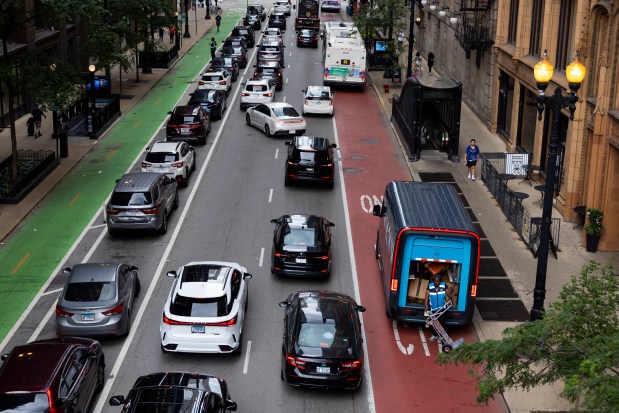
A bike lane ticketing initiative aimed at enhancing safety on busy downtown streets has identified package delivery companies as frequent violators. This revelation aligns with what many Chicago residents observe: trucks and vans parked illegally in the Loop.
The city’s ‘Smart Streets’ pilot program issues warnings and tickets to those blocking bike and bus lanes. Cameras on city vehicles and Chicago Transit Authority buses detect these obstructions, and the Department of Finance processes the fines. Since the program began, approximately 18 months ago, the city has issued thousands of warnings and citations, collecting about $2.6 million in fines, excluding late fees.
Delivery giants like Amazon Logistics, FedEx, and UPS have incurred fines totaling $460,000 for violations from November 2024 to early May. This figure excludes independent contractors using personal vehicles or firms that collaborate with these companies for last-mile delivery. Contractors like Trans One Inc. and Northwest Express Inc., associated with FedEx, also faced fines of $48,000 and $30,000, respectively, for similar violations.
“Safe and responsible delivery is a priority in every community we serve,” stated Amazon spokesperson Leigh Anne Gullett, highlighting that third-party delivery contractors are accountable for their compliance.
The program’s goal is to reduce accidents and fatalities among pedestrians and cyclists and to facilitate more efficient bus travel. It was initiated following a tragic incident in 2022, when a young child died due to a blocked bike lane. Not only does Smart Streets address bike and bus lane violations, but it also targets other parking infringements, such as expired meters.
Companies like Enterprise Mobility either redirect fines to the responsible driver or recover costs post-payment. Chicago comptroller Mike Belsky emphasized the ultimate aim is not revenue generation but safety, by altering illegal parking habits.
Data from the Chicago Department of Transportation suggests that the program is effective. Erica Schroeder mentioned that drivers who receive fines are unlikely to repeat offenses. Initially, 15.6% of violators reoffended within 90 days. As of January 2026, that number has decreased to 7.6%.
The city has issued around 60,000 warning notices. Approximately 16,802 tickets were specifically for bike and bus lane violations, with the total number of citations nearing 30,000. Persistent violators face escalating penalties, including court appearances and possible business operation constraints within the city.
Various delivery companies have faced these fines. FedEx has worked with the city to resolve outstanding violations. UPS and Amazon acknowledged the logistical challenges and reiterate their efforts in maintaining compliance with traffic laws and reducing street congestion.
Initial fines for bus lane and bike lane violations are substantial. Tickets for occupying a bus lane or stop are $90 or $100, and bike lane infractions cost $250.
The ‘Smart Streets’ program, operational since 2024, covers a broad area of the city, encompassing 1,300 bus stops and 70 miles of bike lanes. The CTA plans to expand its camera-equipped buses, focusing on improving safety and efficiency along major routes, with potential future growth depending on city council decisions.
“This program holds immense safety importance,” remarked acting CTA President Nora Leerhsen. Ensuring clear lanes prevents barriers for disabled riders and enhances overall transportation safety.
Christina Whitehouse, of Bike Lane Uprising, warned of the dangers drivers pose when blocking bike lanes, pushing cyclists into unprotected areas of traffic.
The pilot program seeks not only to deter infractions but also to promote a safer and more accessible urban transit environment for all city residents.