
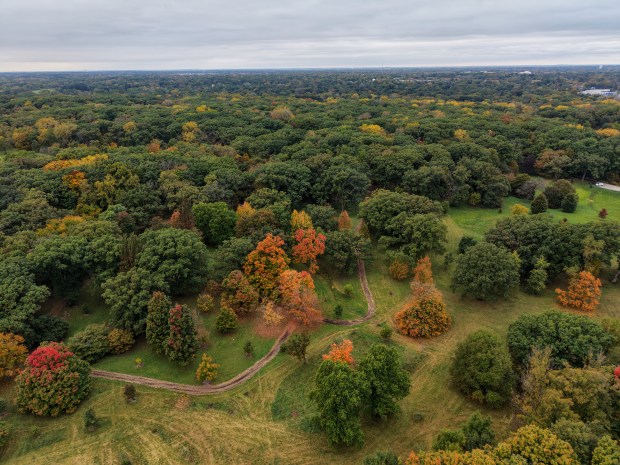
Janet Cole spent another afternoon at The Morton Arboretum, capturing the beauty of trees once again. Despite having numerous photos, she felt drawn to an amur corktree with vibrant leaves. “I wanted to see it with its beautiful, yellow colors,” Cole shared, admiring the tree.
Having retired as a librarian, the 75-year-old Downers Grove resident has volunteered at the arboretum for six years. Her tasks vary from weeding to helping at events like wine tastings. She also enjoys cycling around, answering visitor inquiries. Although Chicago’s winter typically stops biking activities, this year’s unusual warmth may allow her to continue.
Weather Changes and Tree Health
The unusually warm weather is delaying leaf color changes and may impact plant health across the Midwest and the Great Lakes. The National Oceanic and Atmospheric Administration (NOAA) predicts that, globally, temperatures will remain above average in the following months, fueled by the El Niño phenomenon.
Illinois state climatologist Trent Ford explained El Niños affect temperatures rather than predict precipitation accurately. The Great Lakes region faces a 70% likelihood of higher winter temperatures. Ford described this as “about as close to a slam dunk prediction for winter as we can get, as far as temperature is concerned.” This affects when and how trees change their colors, noted Michael Jesiolowski from The Morton Arboretum. Normally, trees start changing as temperatures fall below freezing. However, autumn lows have not dropped significantly, only recently reaching low 40s and high 30s, according to the National Weather Service.
The Impact of El Niño
This alteration in weather patterns can delay the typical mid-October color change for maples and late October for oaks in the Chicago region. While leaves may turn color later, they may last longer if temperatures stay warm. But factors like precipitation and sunlight influence the vividness and consistency of the colors.
The El Niño-Southern Oscillation, a cycle of warming and cooling in the Pacific Ocean, greatly influences Earth’s climate, according to NOAA. The current El Niño is expected to be one of the strongest recorded, impacting global weather. While areas in other parts of the world may face severe effects, Illinois expects warmer than average temperatures, coupled with unpredictable precipitation.
Agriculture and Environmental Concerns
El Niño presents benefits and challenges for agriculture; it may alleviate drought in some areas but worsen pest and weed conditions. Botanist David Zaya noted trends showing higher corn and soybean yields during El Niño years due to longer growing seasons. Yet, cold conditions during planting can cause difficulties.
A milder winter may bring more pests, said Kelly Estes, University of Illinois entomologist. Weeds like horseweed could emerge early and spread quickly, requiring increased herbicide use. Zaya voiced concerns about herbicide drift affecting nearby natural areas, a common issue.
Invasive plant species such as Japanese chaff flower may also spread faster in milder winters, overtaking native species. The absence of cold can disrupt natural checks on invasive growth, Zaya warned.
Aquatic Life and Ecosystem Impacts
Warmer temperatures can affect aquatic organisms, including the proliferation of harmful algae in the Great Lakes. These blooms consume oxygen, threatening fish life. The heat facilitates rapid plankton multiplication, similar to compounding interest, says Casey Godwin from the University of Michigan.
El Niño patterns also impact lake whitefish eggs, which rely on ice for protection. Lack of ice exposes eggs to damage from waves and winds.
Mild Local Effects
While other regions may battle severe weather, the Midwest will likely see mild impacts. Ford hinted homeowners with gardens need to ensure adequate moisture for plants. Trees and gardens could struggle without proper watering and the right gardening practices, according to Jesiolowski.
He suggests deep watering weekly to promote prolonged root growth. Adding mulch and leaves helps retain soil moisture. This “Leave the Leaves” approach not only protects plants but aids in ecological conservation.
At the arboretum, the gradual leaf color change continues. Cole found solace in nature’s transition. “It’s inspiring,” she said. “A distraction from events in the world.”