
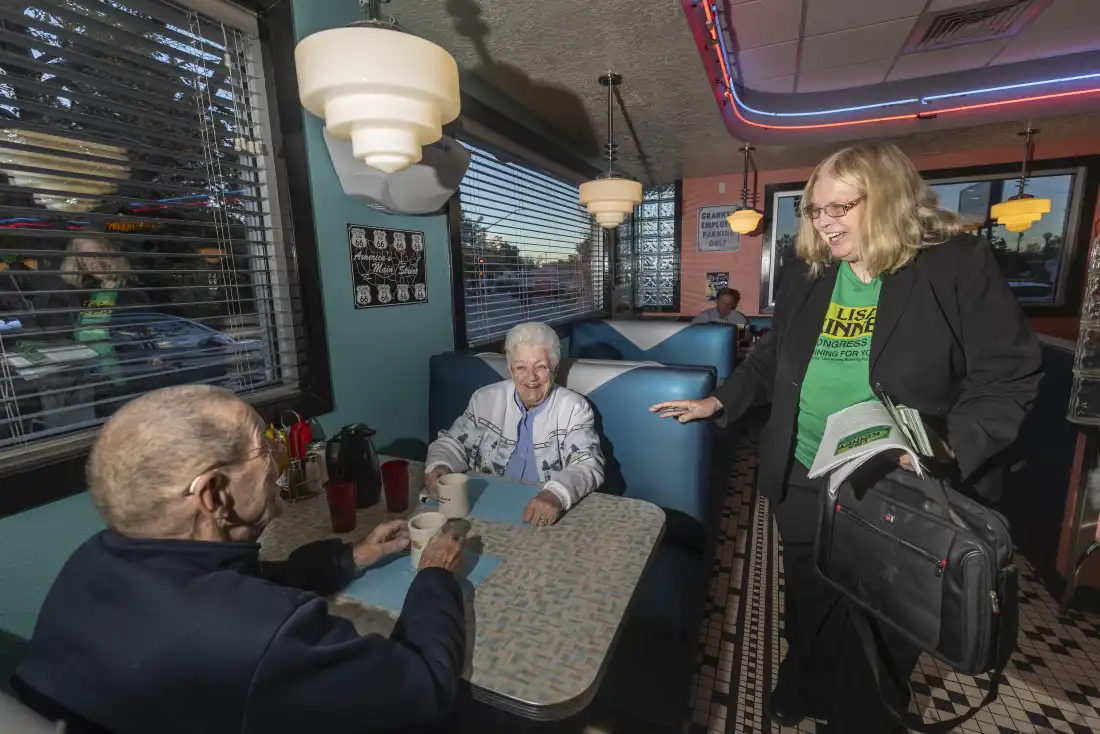
Lisa Kinney campaigns as a Democratic hopeful at Johnny J’s Diner in Casper, Wyoming. Her visit, captured by Natalie Behring for NPR on October 19, 2026, highlights a competitive race where party control of Congress hangs in the balance. Despite the buzz, only a small fraction of races are truly competitive. Most districts lean heavily Republican or Democrat, creating a challenging landscape for those running against the political trend.
In Wyoming, where only Republicans have held the lone House seat since the 1970s, Kinney offers a fresh perspective. ‘I don’t think the people of Wyoming always hear both sides,’ she states. Kinney identifies as a moderate Wyomingite, contrary to opponent ads that associate her with progressive figures like Bernie Sanders and Zohran Mamdani. ‘It’s amusing, but what does he expect? That we’re all organizing socialist activities?’ she jokes during her diner rounds.
At the diner, she encounters a mix of reactions. Some diners prefer their meals politics-free, while others express opposition to Democratic policies on immigration and transgender issues. Hunter Svejkovsky, who transported his horses to Casper due to diesel prices, shows interest as Kinney hands him her campaign information. Joe Beck, a voter disillusioned with Trump but skeptical of change, presents a challenge. Kinney responds by emphasizing her role as a moderate bridge between parties. Their conversation ends with him acknowledging his vote for her, despite low optimism. ‘You’re up against it – this is the reddest state,’ he warns.
With no campaign office, Kinney’s grassroots effort relies on limited support, emphasizing public land preservation and healthcare cost reductions. ‘Meeting voters is crucial,’ she asserts. Her husband, Rodney Lang, defines success beyond election day, focusing on strengthening the party. Despite the odds, Kinney remains hopeful, driven by the belief in potential victory. ‘I know many will choose the ‘R’ next to the name, but winning is always on my mind,’ she admits.
‘You can’t just give it the ole college try.’
Meanwhile, in Connecticut, Republican George Austin shares a parallel journey. ‘I sympathize with anyone in this position,’ he states. Austin challenges the Democratic stronghold of Connecticut’s 2nd Congressional District, represented by Rep. Joe Courtney for two decades. Austin relates to Kinney, both facing entrenched partisanship in their states. Eric Ostermeier from Smart Politics highlights the increase in single-party state delegations, a peak not seen since 1953. Gerrymandering and geographic voter distribution contribute to this trend. State candidates struggle to differentiate from national party identities.
Austin faces skepticism. Conversations often stall at the mention of Trump, though he aims to shift focus to common concerns, like congressional gridlock and AI regulation. His campaign, battling uncontested races for balance, reflects a desire to bring representation diversity. Financially stretched, he dedicates substantial personal funds to the cause, believing in its worth despite the odds. He urges potential candidates to understand the commitment involved. ‘It’s not for everyone – the race demands dedication beyond a mere attempt.’
Despite the uphill battle, Austin sees significance in running. ‘Even if deemed a lost cause, these fights are the ones worth having,’ he concludes. Connecticut Public’s Chris Polansky contributed additional reporting.