
Patients with advanced pancreatic cancer often opt for experimental treatments over chemotherapy. Dr. Zev Wainberg, co-director of UCLA Health’s GI Oncology Program, observed this while leading a trial for daraxonrasib, a promising new drug. Many trial participants had previously undergone failing chemotherapy treatments. “Statistically, only half receive the pill,” Wainberg explained, noting that those placed on the chemotherapy arm of the trial were no longer alive. He described the study as one of the most emotionally charged he had ever encountered.
Daraxonrasib is generating significant interest, with a phase 3 trial involving 500 patients showing the drug doubled survival time—averaging 13.2 months as opposed to 6.7 months with chemotherapy. These findings were announced at the American Society of Clinical Oncology’s annual meeting in Chicago, followed by publication in the New England Journal of Medicine.
Revolution Medicines, the drug’s manufacturer, initially released early trial results in April. Following the announcement, Dr. Rachna Shroff from the University of Arizona Cancer Center expressed her joy by stating, “It’s unprecedented,” recognizing the drug as a major advancement for pancreatic cancer treatment. Daraxonrasib takes aim at the KRAS gene mutation found in many cancers, including lung, colorectal, ovarian, and bile duct cancer.
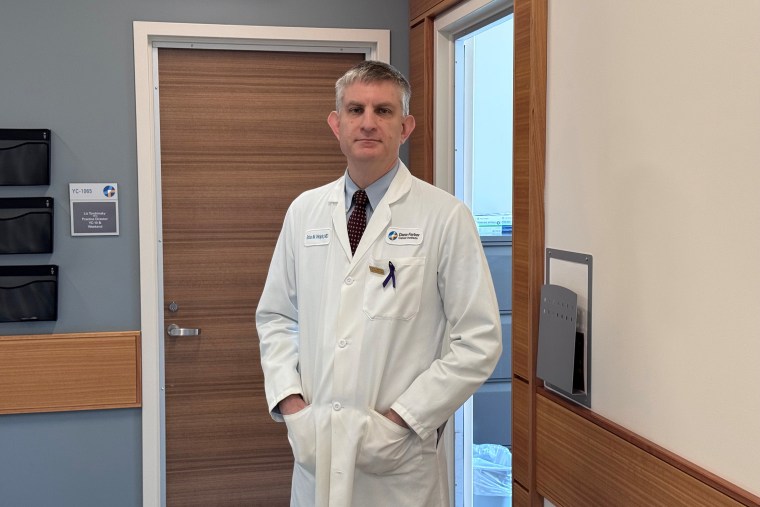
Dr. Brian Wolpin, director at Dana-Farber Cancer Institute, also worked on daraxonrasib research. He believes that although pancreatic cancer is the initial target, the drug holds potential for other cancers, marking the start of new possibilities. The Food and Drug Administration has expedited daraxonrasib’s approval process, even allowing for an expanded access program to distribute the medication outside clinical trials.
Dr. Mark Goldsmith, CEO of Revolution Medicines, refrained from committing to a specific timeline for FDA approval but confirmed that his team was working tirelessly to prepare for it. Many pancreatic cancers are diagnosed too late for surgical intervention, leaving patients with limited options.
Dr. Sameek Roychowdhury, from Ohio State University Comprehensive Cancer Center, noted, “Even with our best chemotherapies, the average benefit is around 6 months.” The American Cancer Society reports only a 3% survival rate after five years for those with metastatic pancreatic cancer.
In April 2024, Debby Orcutt, a 71-year-old, was diagnosed with stage 4 pancreatic cancer that had metastasized to her liver. She experienced persistent abdominal pain that worsened at night prior to diagnosis. When her chemotherapy showed signs of failure, Orcutt participated in the daraxonrasib clinical trial. Since January 2025, she has been taking the pill, witnessing significant progress as her liver spot disappeared and her pancreatic tumor shrank by 80%.
Orcutt expressed optimism, stating, “I feel great every single day,” ignoring the fact she has pancreatic cancer. Dr. Roychowdhury and Dr. Shroff have started assembling patient lists for daraxonrasib once it becomes readily available. Shroff is eager to incorporate it into treatment plans once approved.
Understanding Daraxonrasib
Daraxonrasib targets the KRAS gene mutation responsible for uncontrollable cancer cell growth. This mutation is present in over 90% of pancreatic cancers. Scientists have long attempted to inhibit KRAS, compared by Dr. Wolpin to a “round ball” challenging for drugs to latch onto. Thanks to advanced chemistry, daraxonrasib interacts with cyclophilin A protein inside cells, forming “molecular glue” that clings to the mutated protein. Other similar drugs are now under study.
Although not a cancer cure, daraxonrasib could significantly reduce chemotherapy reliance. Revolution Medicines is testing three additional RAS inhibitors, with a fourth set to enter trials soon.
While daraxonrasib’s effectiveness extends beyond mutation targeting, overall survival improved irrespective of KRAS mutation presence. Dr. Wolpin anticipates, “This drug is relevant to all patients with pancreatic cancer, assuming they have metastatic cancer.” Current chemotherapy remains the first-choice treatment but ongoing research might change that.
Daraxonrasib exhibits fewer toxic effects than chemotherapy. Some patients reported side effects like vomiting, diarrhea, and mouth sores. Others developed a blistering rash resembling severe sunburn, which Ben Sasse described as “nuclear.” Despite minor side effects, Orcutt remains positive, saying, “How can I complain about a little rash?”
Debby Orcutt and her husband of 47 years, Ron, have been dedicated partners since their teenage years working part-time jobs. He ensures precise timing for her daraxonrasib doses alongside their routine activities. Despite needing no financial support, Orcutt maintains part-time work for activity and engagement.
“You’ve just got to keep going and have faith,” she remarked. “I feel like I’ve been given a second chance, and might as well make the most of it.”