
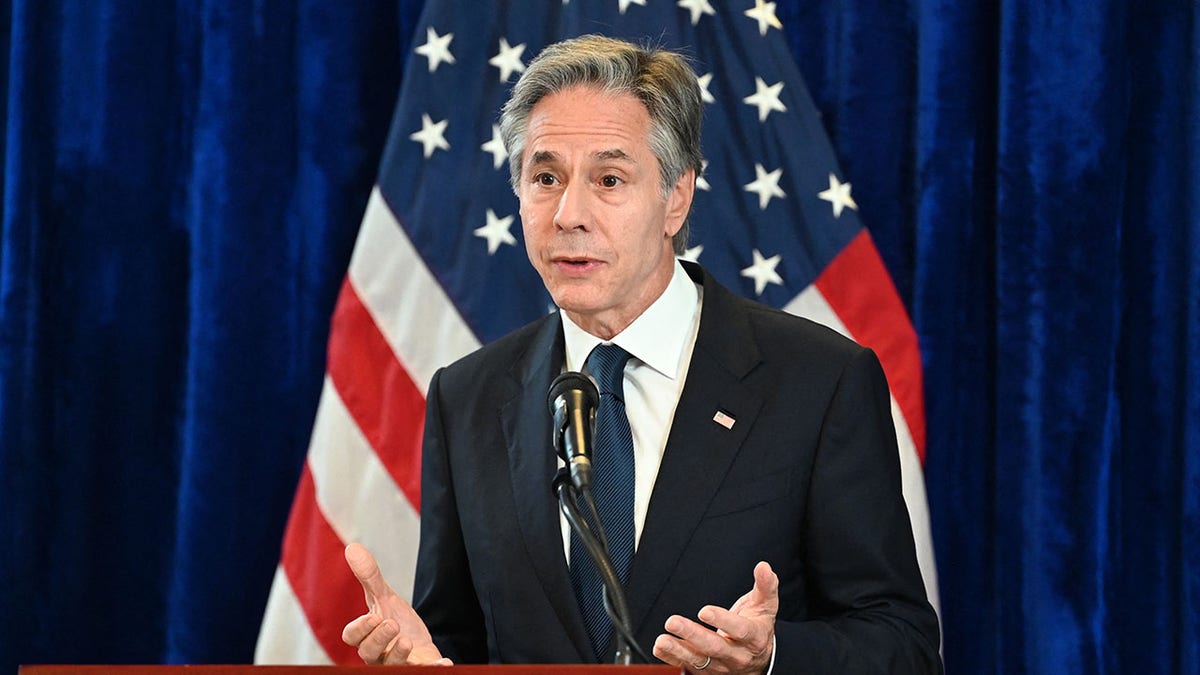
Former Secretary of State Antony Blinken addressed the feasibility of addressing Iran’s military capabilities using airstrikes. During the Hindustan Times Leadership Summit in New Delhi, he emphasized the challenges of disarming Iran solely through air assaults. Blinken highlighted Iran’s considerable size, its population nearing 90 million, and its capability to produce weapons domestically as significant hurdles.
“The weapons that it continues to produce are back far enough, the range is great enough that taking everything out is not feasible,” Blinken noted. He elaborated that a land invasion might become necessary but deemed such a move an “absolute disaster.”
Amid growing tensions, Iran claimed to have launched six drones against a U.S. military base in Bahrain. However, Bahraini air defenses reportedly intercepted the threats. The attacks aimed at a U.S. air defense radar at the Al-Rifaa helicopter base, described as retaliation against “hostile US actions,” according to Iranian state media.
Blinken further discussed potential conflict escalation, mentioning concerns in neighboring Iraq, where worries about involvement in a ground operation are rising. Bahrain’s recent interception of aerial attacks, the first since September, adds to the regional tensions.
In Yemen, conflict continues as the Houthis make advances against forces backed by Saudi Arabia. This raises fears of the conflict spreading regionally. Blinken warned of Iran’s ability to extend conflict across the region despite U.S. military superiority.
“Even though we’re much more powerful, Iran’s ability to escalate horizontally rather than vertically is not in our favor,” Blinken remarked.
The geographic challenge is significant. The Strait of Hormuz presents difficulties, and Iran’s considerable size, being four times that of California, complicates military operations.
Concerns have heightened in Iraq regarding potential military actions across its border with Iran. Reports from the Iraqi press suggested American plans for a ground offensive, spurring diplomatic discussions and local unease.
In an interview with France 24, Iraqi Foreign Minister Fuad Hussein expressed the untenable state of “no war and no peace” in the region. He urged for a direction towards either peace or war resolution and emphasized Iraq’s active diplomatic involvement.
CENTCOM’s recent efforts to counter Iranian weapons transport reflect the continuing tension. Task Force Iron Gate, coordinated by CENTCOM, aims to mitigate illicit Iranian activities, focusing on controlling sea and border movements.
Iraq’s diplomatic stance involves maintaining open borders with Iran, countering proposed U.S. restrictions on crossings. Iraqi officials defend keepings border transactions open due to their economic and social impacts.