
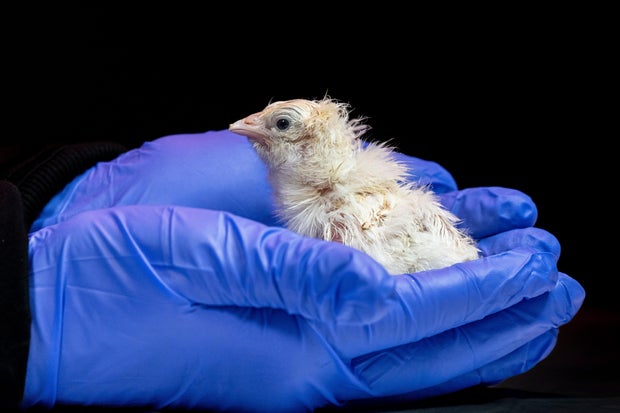
A biotech firm announced on Tuesday the successful hatching of live chicks in an artificial environment. This development aims to further the company’s mission of de-extincting lost species, but it has prompted mixed reactions from the scientific community.
Artificial Egg Hatchings
Colossal Biosciences reported the birth of twenty-six chicks from a 3D-printed lattice framework that simulates an eggshell. These chicks range from a few days to several months old. Earlier, Colossal had engineered animals like mice with traits similar to the woolly mammoth and dire wolf-like pups.
CEO Ben Lamm explained the potential expansion of this technology to modify birds to mimic New Zealand’s extinct South Island giant moa. These birds had eggs 80 times larger than a chicken’s egg.
Lamm stated, “We wanted to enhance and scale nature’s design for efficiency.” The company shared images and videos showing scientists handling the chicks with care.
Scientific Doubts
Despite these advancements, independent scientists argue that the technology is not a complete artificial egg. It is instead characterized as an artificial eggshell. According to evolutionary biologist Vincent Lynch, while the technology could create genetically modified birds, it cannot bring back extinct species like the moa.
“It’s not a moa,” Lynch emphasized.
For the hatching process, the team placed fertilized eggs in the artificial system, added calcium, and monitored embryo development in real time. Colossal created an eggshell membrane allowing oxygen intake, but key components such as organs that nourish the chick were not included.
Past research has used basic technologies to create transparent eggshells for chick observation, beneficial for studying development in different species.
Nicola Hemmings, an expert in bird reproductive biology from the University of Sheffield, noted that hatching from an artificial vessel isn’t unprecedented. Hemmings is not affiliated with Colossal.
Long-Term Goals and Concerns
For a potential moa resurrection, Colossal needs to compare ancient DNA from fossilized moa remains with living birds’ genomes. Moreover, they will require a larger eggshell.
Lamm said, “We didn’t want to wait to be ready for a giant moa. Engineering challenges for surrogacy and birth are starting now.” Even if successful, some experts question how such an animal would adapt to today’s environment.
Bioethicist Arthur Caplan from NYU’s Grossman School of Medicine asked, “What environment will this animal live in?” Some suggest focusing on rescuing endangered species before attempting de-extinction.
Hemmings shared her preference for conservation, “Preserving current species matters more than bringing back what’s gone.” Colossal argues that their platform could aid in rescuing bird embryos and possibly revive species preserved as frozen DNA.
Previous Initiatives
Colossal made headlines in 2021 with plans to revive the woolly mammoth and the dodo bird. In 2024, they claimed a breakthrough with the extinct Tasmanian tiger. In 2023, CEO Lamm discussed these ambitions with CBS News, acknowledging the science fiction-like nature of their goals.
The company has shared their work on social media, stating that birds are facing significant decline and their technology could make a difference in preserving various species.