
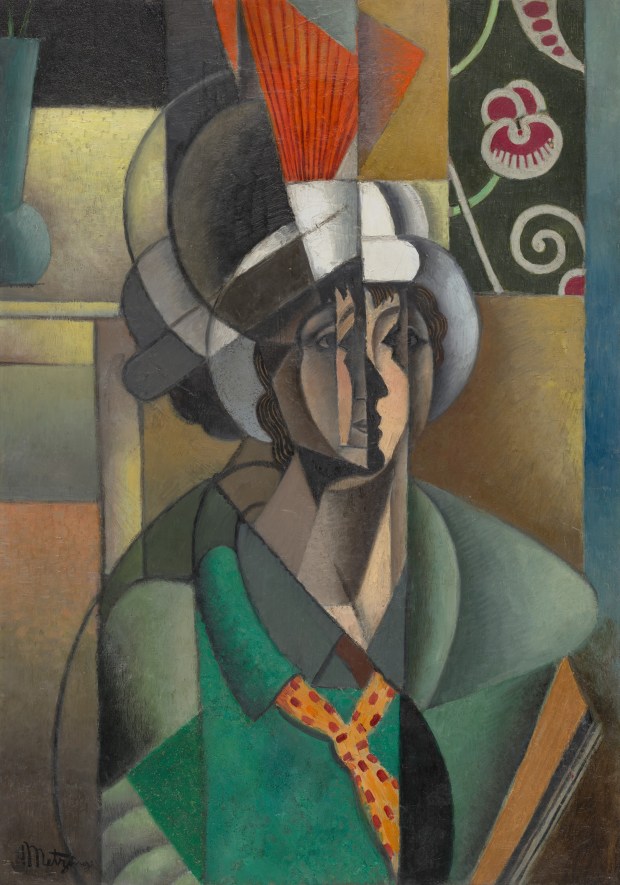
For over three decades, descendants of Jewish art collectors have pursued the return of artworks looted by the Nazis in World War II. Recently, the Art Institute of Chicago announced it will return the 1913 painting “Woman with a Fan” by Jean Metzinger to the heirs of Emanuel Lewenstein, its original owner.
Jacques Schuhmacher, executive director of provenance research at the museum, stated the painting belonged to the Lewenstein family, a Jewish family from Amsterdam. It was sold in a forced sale in Nazi-occupied Amsterdam in 1940.
The Art Institute collaborated with Mondex Corp., a Canadian company specializing in recovering looted artworks, to facilitate this restitution. Mondex represents the Lewenstein heirs.
Emanuel Lewenstein was an avid art collector, supported by his family fortune from a sewing machine business. He amassed a collection that included works by Dutch contemporary artists and prints by old masters, such as Rembrandt, possibly inherited from his father. Lewenstein passed away in 1930, and after his wife’s death in 1937, the collection passed to their children, Wilhelmine and Robert, who fled due to the Nazi invasion.
The artworks remained behind and were sold by an auction house known for arranging sales of looted art during the war.
Provenance research involves tracing an artwork’s ownership history. Schuhmacher noted this task is challenging due to scattered records worldwide. Historically, art transactions often lacked comprehensive documentation.
The Art Institute possesses around 300,000 objects, with some having provenance gaps. While a gap doesn’t imply looting, it warrants investigation. The museum acquired “Woman with a Fan” in 1959. Metzinger is regarded as a leading figure in Cubism, presenting the subject in shapes and planes.
Provenance awareness gained momentum in the 1990s, spurred by a US State Department conference spotlighting Nazi-era looted art, leading museums to scrutinize their collections. This drove the Art Institute to examine artworks like the current restitution.
On its website, the museum listed the painting due to gaps during the World War II period, hoping someone could aid in unraveling its history. Mondex shared previously unknown family history connecting the painting to the Lewenstein family.
A crucial finding emerged from faint pencil writing on the artwork’s reverse, visible via infrared photography. It identified Paul Citroen, Lewenstein’s cousin, who impacted Lewenstein’s collection. Citroen transported numerous artworks from Berlin to the Netherlands around 1919, from which Emanuel acquired paintings, including Metzinger’s.
In contrast, another artwork under dispute, Egon Schiele’s 1916 drawing “Russian War Prisoner,” lacks definitive evidence of Nazi-era duress, affecting its court case outcome.
Schuhmacher emphasized that museums typically lack dedicated provenance research departments, despite its specialization. The Art Institute is arranging the return of the painting to Lewenstein’s descendants.