
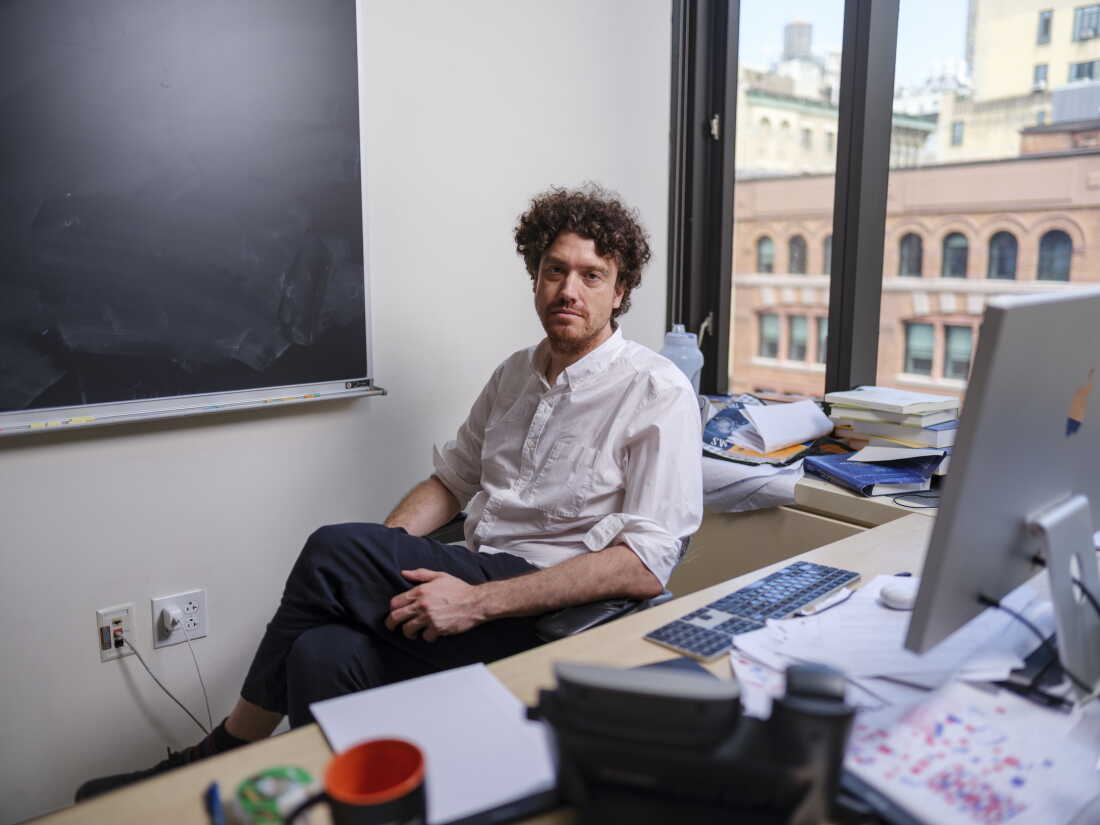
The world of mathematics is buzzing with recent events surrounding the Navier-Stokes equations. At the heart of the drama are Tristan Buckmaster, a mathematician at New York University, and Levent Alpöge, who have been researching these equations. Their work has collided with claims from OpenAI that they have resolved one of the toughest math challenges.
OpenAI recently announced that its AI had solved the Navier-Stokes problem. The tone of the announcement was celebratory, emphasizing the advancement of research and technology for humanity’s benefit. However, the mathematical community is skeptical. While they acknowledge the technical correctness of the AI-generated proof, the dense 166-page document is proving a challenging read.
It has been very difficult to extract any human understanding from this AI proof,
said James Maynard, a mathematician from Oxford University. Javier Gómez-Serrano from Brown University, who uses AI in his own work, expressed that the proof may advance mathematics but requires substantial rewriting for comprehension. Presently, the paper provides little educational insight.
AI is rapidly gaining ground in mathematics, and large language models are producing significant results. Although OpenAI’s announcement arrived as human mathematicians approached a solution, few see this as a harmonious example of AI collaborating with humans. Maynard highlighted the missed opportunity for collaboration, citing misaligned goals
between AI firms and mathematical communities.
OpenAI’s solution targets the Navier-Stokes problem, an eminent question in mathematics concerning fluid flow equations. These equations, pivotal in physics and engineering, remain enigmatic at a fundamental level. Buckmaster suggests deeper understanding could offer new tools for analyzing fluid solutions, potentially improving models like turbulence in fluids and lift in aircraft.
Efforts to discover scenarios where Navier-Stokes equations fail became one of the $1 million Millennium Prize Problems established by the Clay Mathematics Institute in 2000. Mathematicians were closing in on a solution. Among the seven Millennium Problems, Martin Hairer from EPFL noted consensus that Navier-Stokes was next in line for resolution.
Buckmaster and Alpöge were leveraging AI, including OpenAI’s chatbot, to explore potential solutions. However, OpenAI’s announcement incited controversy when Buckmaster disclosed how the company approached him to drop Alpöge in exchange for co-authorship. Buckmaster suspects OpenAI learned of his progress through undisclosed means, possibly involving AI agents.
OpenAI denied using any direct insights from Buckmaster and Alpöge. However, the rushed solution presented by OpenAI seemed jumbled. Mathematicians criticized the paper’s readability. Buckmaster himself admitted his own AI-influenced preliminary results were hastily published due to OpenAI’s actions, stressing the introduction contained the essential ideas.
Despite difficulties reading OpenAI’s proof, it’s widely accepted. OpenAI provided a Lean formalization—a piece of computer code validating proof correctness through a programming language used for mathematical checks. The code compiled successfully, suggesting correctness according to experts like Gómez-Serrano.
This episode demonstrates AI’s potential in mathematics but serves as a reminder that human understanding is indispensable beyond mere problem-solving. Maynard concluded that while solutions are crucial, the understanding behind them is equally important.