
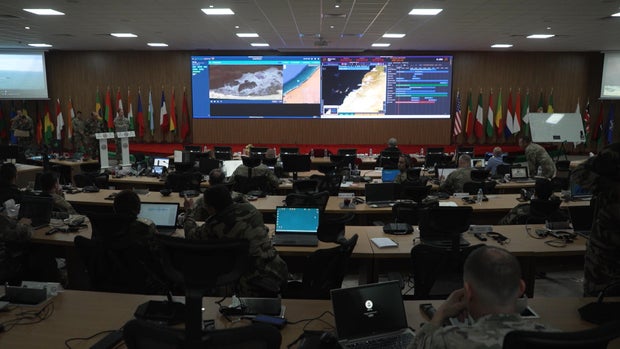
In southern Morocco, where the Sahara Desert meets the Atlantic coast, the calm desert atmosphere recently erupted with sounds of explosions and gunfire. This was the setting for the African Lion 2026 military exercise, where American forces alongside 30 partner nations engaged in war games testing AI capabilities.
AI in Military Exercises
African Lion is the largest U.S.-led military exercise in Africa. This year, AI played a critical role in modernizing warfare practices. Over a dozen private defense contractors participated, showcasing their products and receiving direct feedback from soldiers.
Reducing the Time to ‘Kill’
A focal point of the exercise was to shorten the “kill chain,” the process from target identification to action. U.S. Army Lt. Col. Ramon Leonguerrero explained that an AI-driven platform developed by Palantir was used to expedite decision-making. What used to take hours now takes minutes, highlighting the efficiency AI brings to military operations. The platform involved is part of Project Maven, the Pentagon’s flagship AI initiative, which processes vast amounts of battlefield data to prioritize information for commanders.
AI’s Role According to Anthropic
The interface for interacting with battlefield intelligence employed Anthropic’s Claude large language model. Despite tensions with the Pentagon, Claude continues to play a significant role. The AI helps military personnel process complex data in straightforward language, though Anthropic has resisted its use for mass surveillance or fully autonomous weapons.
Ethical Considerations
AI autonomy in combat raises ethical concerns. A U.S. soldier in Morocco doubted if critical decisions could be entrusted to machines, emphasizing the need for human oversight. General Dagvin R.M. Anderson commented on the rapid evolution of AI, noting that while its use is crucial, ethical implications can’t be ignored.
Robotics on the Battlefield
Artificial intelligence isn’t only about rapid data processing. The exercises also focused on autonomous vehicles like Overland AI’s ULTRA. This vehicle can navigate autonomously, carrying weaponry while keeping human operators safe from the front lines.
Tim Bishop of Overland AI highlighted the ULTRA’s potential to protect soldiers by performing tasks such as laying mines and deploying explosives. The potential to automate the machine gun function exists, with safety and human life as a priority.
1st Lt. Vincent Gasparri, leading the 173rd Airborne Brigade’s Bayonet Innovation Team, emphasized the role of AI and robotics in saving lives by replacing soldiers with robots for dangerous tasks. This focus on saving lives drives ongoing innovations in military operations.