
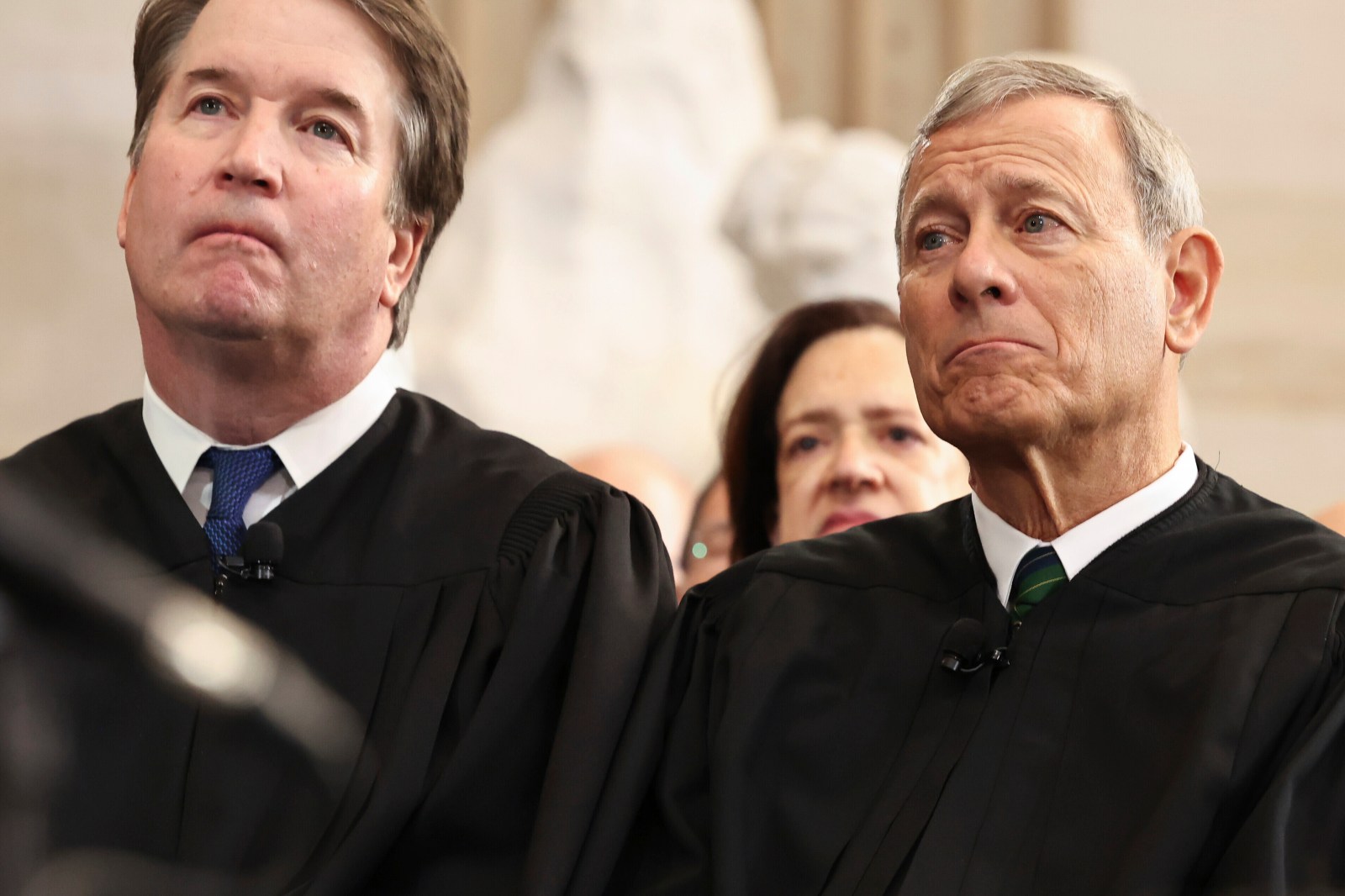
The Supreme Court decided on Thursday that Terry Pitchford, a Black Mississippi death row inmate, can pursue new challenges to his conviction. This 5-4 ruling shows a split in the conservative-majority court regarding how they address claims of racial bias during jury selection. Chief Justice John Roberts and Justice Brett Kavanaugh sided with the court’s liberal justices. The decision reopens Pitchford’s long-standing legal battle and sends the case back to the lower courts.
Mr. Pitchford is now entitled to a fair trial in the state court,
said Joseph Perkovich, who presented Pitchford’s case at the Supreme Court, as reported by the Associated Press.
A Split Over Racial Bias
The main issue was whether prosecutors wrongly dismissed Black prospective jurors during Pitchford’s 2006 trial. He was sentenced to death for his involvement in the robbery and murder of Reuben Britt, a grocery store owner in northern Mississippi. During the trial, prosecutors removed four out of five eligible Black jurors, which left a jury with only one Black member. This prompted defense attorneys to object, citing racial motivations.
This case is connected to the 1986 Batson v. Kentucky ruling, which forbids the exclusion of jurors based on race. Courts must closely examine prosecutors’ reasons for juror removal. Pitchford’s legal team claimed they were not given a fair opportunity to argue against these reasons. A federal district judge agreed in 2023, overturning his conviction, but this was reversed by the 5th U.S. Circuit Court of Appeals.
Kavanaugh, in the majority opinion, wrote that the trial court did not adequately allow Pitchford’s attorneys to contest the prosecutor’s race-neutral reasons and failed to determine if these reasons were a cover for discrimination.
In contrast, Justice Neil Gorsuch, in dissent, pointed out that the prosecutors provided legitimate reasons for striking the jurors, highlighting issues like tardiness and a lack of opinion on the death penalty.
The Case of Doug Evans and Similarities to Flowers v. Mississippi
This case reminds many of Flowers v. Mississippi, where the Supreme Court overturned a conviction under the same prosecutor, Doug Evans, due to attempts to exclude Black jurors. Evans also prosecuted Pitchford’s case, and the same judge, Joseph Loper, presided. Similar accusations of racial bias and inappropriate juror dismissals characterize both cases.
Who is Terry Pitchford?
Terry Pitchford, now 40, was only 18 during the 2004 robbery that resulted in Britt’s death. His accomplice, who was underage, fired the fatal shots and could not receive the death penalty. Pitchford was convicted and sentenced to death in 2006.
Pitchford has remained on death row for nearly 20 years, arguing that racial bias compromised his jury selection. His legal fight focused on whether courts correctly assessed the claimed biases rather than outright proving discrimination. Defense attorneys claim the trial judge hampered their efforts to challenge the prosecution’s motives, a concern the Supreme Court deemed worthy of further review.
This is a developing story with further updates to follow.