
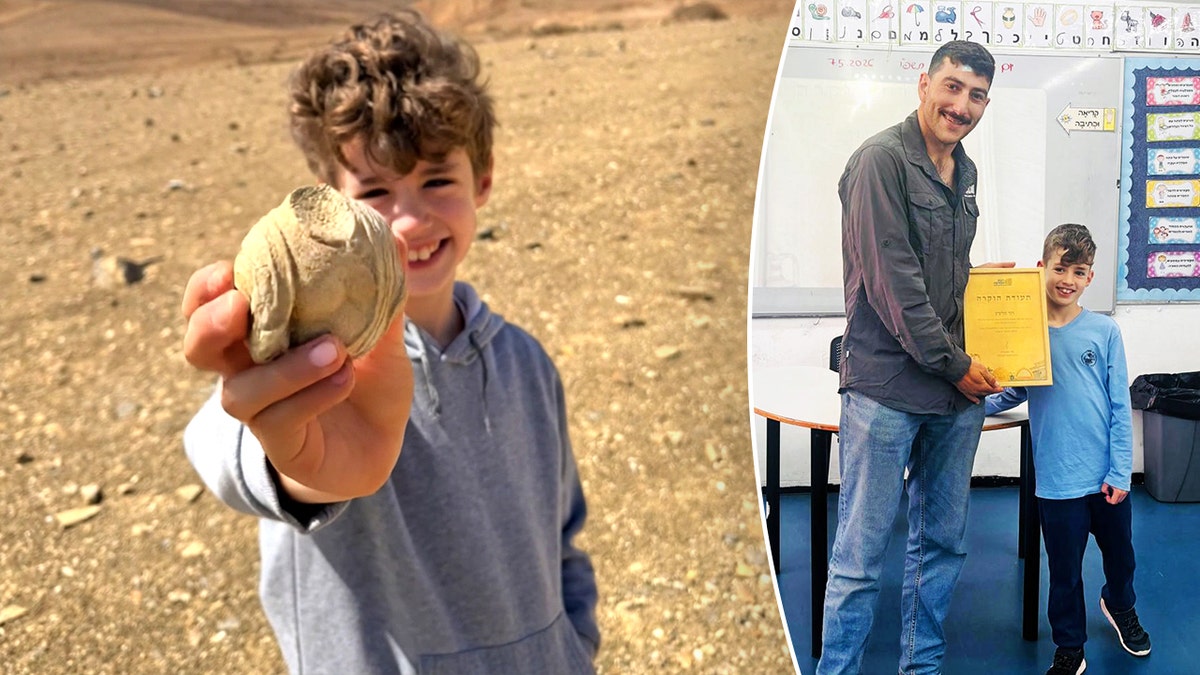
An eight-year-old child from Rehovot, Israel, Dor Wolynitz, made an intriguing discovery during a family trip to the Ramon Crater in the Negev Desert. The child found a fragment of a 1,700-year-old Roman statuette, a discovery later confirmed by the Israel Antiquities Authority (IAA).
During a family weekend retreat organized by a paratrooper reserve unit, Wolynitz came across the artifact. He was actively searching for interesting objects to showcase in his class when he spotted a unique stone with stripes and decided to pick it up.
It seemed like an unusual object to me,
he remarked, explaining that he later showed the stone to Akiva Goldenhersh, an archaeologist accompanying his father’s friend on the trip.
The statuette fragment measures approximately six by six centimeters, featuring a portion of a human figure with precisely sculpted fabric folds, detailed Goldenhersh, who supervises the IAA’s Antiquities Theft Prevention Unit.
Initially perceiving the piece as a fossil, Goldenhersh recognized its significance upon noticing the intricately sculpted garment folds. The artifact is believed to have originated locally, made from phosphorite native to the Negev, dating back to the fourth century A.D.
The statuette, thought to depict either the Roman god Jupiter or the Nabatean deity Zeus-Dushara, was found on the surface of the Negev Desert rather than within a controlled excavation site, which is notably uncommon.
The Ramon Crater region aligns with the ancient spice route from Roman and Nabatean times, suggesting interactions among various cultures that may have influenced the statuette’s design. Researchers speculate it was crafted with high skill without visible undergarments, like a chiton, instead wearing a hefty mantle called a himation.
Goldenhersh emphasized the rarity of finding Roman-era stone figurines in this style, especially as surface finds. Natural factors such as erosion or the shifting desert landscape might have caused the fragment to detach from its original location.
The desert conditions potentially aided in preserving the artifact, which later emerged on the surface for discovery.
In a commendable gesture, Wolynitz handed the find to Israel’s National Treasures Department, receiving a certificate acknowledging his good citizenship. His proactive reporting exemplified civic responsibility in preserving cultural treasures, earning praise from Goldenhersh: Dor is a role model for us all.