
Washington — Each night when Congress is active, a team of workers undertakes a critical yet unheralded task. They lay down the first draft of Congress’s history within a large red-brick structure near the Capitol.
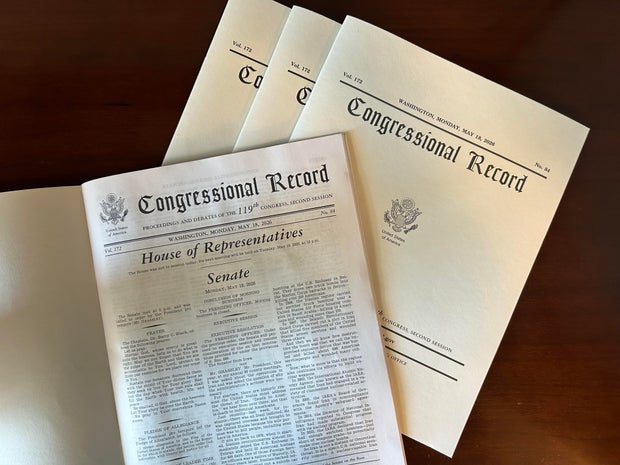
The Government Publishing Office (GPO), located here, is responsible for producing the Congressional Record. This record has been vital since 1873, offering a comprehensive daily account of activities on Capitol Hill. The Record meticulously documents speeches, actions, and legislative processes with precision and detail.
A substantial verbatim account has been maintained, shifting from sparse newspaper coverage before 1873 to a formalized systematic documentation. The need for consistent records led to the inaugural publication of the Congressional Record by the GPO on March 5, 1873.
Lyndon B. Johnson once highlighted the significance of this document, emphasizing its role in preserving debates and legislative actions. The Record’s layout features formal pages with the U.S. seal, varying in thickness based on Congressional activity. It includes speeches, a ‘Daily Digest’, and sections for remarks never spoken aloud.
An example of controversy includes speeches added posthumously, as seen in the case of Rep. Hale Boggs in 1972. This raised questions about authenticity, prompting changes to indicate when speeches were added later. Further reforms have since insisted on clarity, not substance editing.
Even after the introduction of cameras in Congress, the Record continues to offer a fuller perspective of proceedings. It aims to provide a broad account of legislative issues and debates.
The process of creating the Record starts in the Capitol with floor reporters logging every speech and action. These reporters use shorthand, recording up to 225 words per minute, and collaborate with scopists and editors to produce polished transcripts. It takes about an hour and a half per fifteen minutes of House floor time, with more substantial time needed for the Senate.
Post-editing, materials are transported to the GPO, a seven-story Romanesque Revival building established in 1903. The paper document is considered the ‘source of truth,’ as GPO Director Hugh Halpern points out.
GPO specialists then compile transcripts with vote tallies and committee reports. This process concludes with formatting instructions and proofing stages at the GPO headquarters, as detailed by customer service office staff.
The cycle of producing the Record is akin to an orchestra, performed by skilled proofreaders and specialists working in synchronized shifts.
At the GPO’s printing floor, modern machines print and assemble the Record efficiently. This space, echoing its history with faded bricks and tiles, is equipped for high-volume production, thanks to digital inkjet technology.
As of the 1980s and 90s, the number of daily printed copies dropped significantly, though the Record’s importance on Capitol Hill persists, primarily digitally served.
Reflecting on the future, Halpern acknowledges that the Congressional Record must keep evolving. Modernization efforts include updating software and investigating ways AI might assist without replacing skilled proofreaders.
Standing within the historic printing areas at GPO, Halpern underscores the journey of ongoing improvement and readiness to adapt.
The GPO’s mission echoes the legislative needs, continuously refining processes to uphold the accuracy and integrity of the Congressional Record.