
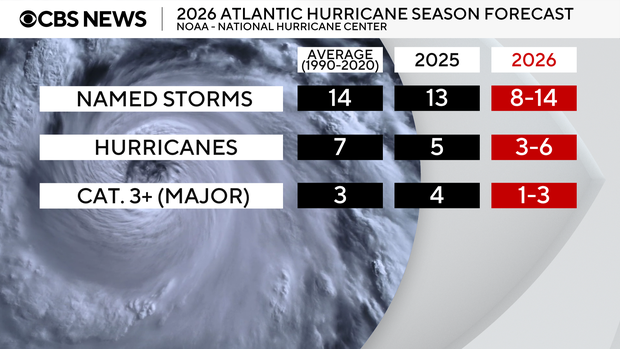
The Atlantic hurricane season for 2026 is fast approaching, beginning on June 1, as residents of coastal areas watch the forecasts closely. The National Oceanic and Atmospheric Administration (NOAA) has released its preliminary outlook for the months ahead, predicting a below-average season.
NOAA forecasts eight to 14 named storms this year, of which three to six may develop into hurricanes. Among these, one to three could become major hurricanes, classified as Category 3 or higher. NOAA officials emphasize the importance of preparation despite the prediction of a below-average season.
“Even though we’re expecting a below-average season in the Atlantic, it’s very important to understand that it only takes one,” said NOAA administrator Neil Jacobs.
Jacobs and Ken Graham, National Weather Service director, highlighted improvements in technology that aid storm preparedness. Ken Graham believes that technological advancements have greatly enhanced readiness for hurricane season.
According to NOAA, there is a 55% likelihood of below-normal activity, a 35% chance of near-normal activity, and a 10% possibility of above-normal activity during the hurricane season.
A storm receives a name when its maximum sustained wind speeds reach at least 39 mph, and it becomes a hurricane if those winds increase to 74 mph. Hurricanes reaching wind speeds of at least 111 mph are classified as major hurricanes, placing them in Category 3 or above on the Saffir-Simpson Scale. The Atlantic hurricane season extends through November 30, with peak activity typically occurring between August and October.
NOAA will update its outlook throughout the summer to reflect any changes in the forecast.
NOAA’s Accuracy in Previous Forecasts
NOAA’s predictions are generally reliable, though not always exact. The agency’s forecast for 2025 was initially set for 13 to 19 named storms, six to 10 hurricanes, and three to five major hurricanes. This was later adjusted to forecast 13 to 18 named storms, five to nine hurricanes, and two to five major hurricanes. In 2025, 13 named storms occurred, which included five hurricanes, four of which were major hurricanes.
Impact of El Niño on the 2026 Season
El Niño, a climate pattern impacting weather across the U.S., can potentially influence the 2026 hurricane season. Historically, El Niño correlates with fewer storms in the Atlantic. However, it may not mean a complete absence of such systems; rather, there may be fewer than average.
Conversely, on the West Coast, warmer Pacific waters brought about by El Niño can enable tropical storms and hurricanes in the Pacific. NOAA’s Climate Prediction Center indicates an 82% likelihood of El Niño’s arrival by July.
CSU’s Hurricane Forecast
Approximately six weeks before NOAA’s announcement, Colorado State University (CSU) released its hurricane forecast. CSU predicts slightly less activity than usual in the Atlantic basin, estimating 13 names storms, including six hurricanes and two major hurricanes for the upcoming season.
2026 Storm Names
Each year, the World Meteorological Organization compiles a list of names for storms that may develop during the Atlantic season. If more than 21 storms form, a supplemental list is used. Here are the names for 2026:
- Arthur
- Bertha
- Cristobal
- Dolly
- Edouard
- Fay
- Gonzalo
- Hanna
- Isaias
- Josephine
- Kyle
- Leah
- Marco
- Nana
- Omar
- Paulette
- Rene
- Sally
- Teddy
- Vicky
- Wilfred