
Three Red Cross volunteers lost their lives, believed to have contracted the Ebola virus, during a humanitarian mission in the Democratic Republic of the Congo in March. The International Federation of Red Cross and Red Crescent Societies (IFRC) reported that at the time of the intervention, the community was unaware of the Ebola Virus Disease outbreak, which had not been identified then. These volunteers represent the initial known victims of the outbreak.
The volunteers, identified as Alikana Udumusi Augustin, Sezabo Katanabo, and Ajiko Chandiru Viviane, died in May. Viviane passed away on May 5, Katanabo on May 15, and Augustin on May 16. They likely contracted the virus on March 27 while managing dead body activities unrelated to Ebola.
Serving in the Mongbwalu branch of the Djugu territory in the Ituri province, the epicenter of the outbreak, these volunteers were part of Congo’s Red Cross society. The IFRC expressed their heartfelt condolences to the families, loved ones, fellow volunteers, and colleagues of those who died serving their communities.
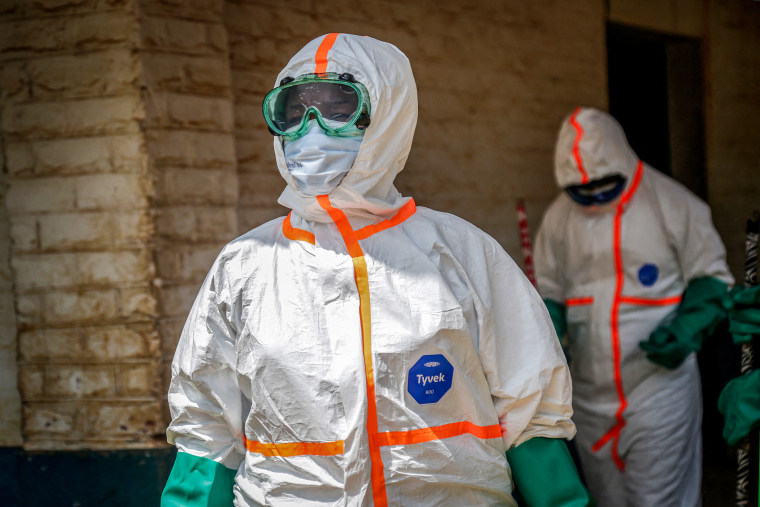
As the outbreak expanded, health workers, equipped in protective gear, worked to disinfect the isolation area for Ebola patients at the General Referral Hospital of Mongbwalu. They also monitored visitors arriving at the Rodolphe Mérieux Laboratory, National Biomedical Research Institute, in Goma, Congo.
Virus spreads to Uganda
The World Health Organization (WHO) declared the outbreak in Congo, which has now extended into Uganda, a public health emergency of international concern on May 17. As of last Thursday, Congo reported 746 suspected Ebola cases and 176 deaths among these cases. There have been 88 confirmed cases, with 10 deaths, including one in Uganda.
An American surgeon contracted the virus while in Congo and was transported to Germany for treatment. As of Thursday, Uganda had reported two cases. However, by Sunday, the Ugandan Ministry of Health revealed the cases had increased to five. These included a driver who had transported the country’s first confirmed case, a health worker exposed during care, and a Congolese woman presenting mild abdominal symptoms. All are receiving medical care.
‘Worrisome’ outbreak
WHO Director-General Tedros Adhanom Ghebreyesus described the situation in Congo as “deeply worrisome.” He emphasized that although surveillance and testing efforts are improving, violence and insecurity continue to hinder the response efforts.
Regional and international partners, such as WHO, the U.S. Centers for Disease Control and Prevention, the European Centre for Disease Prevention and Control, Doctors Without Borders, and the U.S. State Department, have offered aid and personnel to Congo. The U.S. State Department has mobilized $23 million in foreign assistance.
The outbreak, driven by the Bundibugyo strain of Ebola, causes hemorrhagic fever and currently has no approved vaccines or treatments. In response to the situation, the CDC issued an order on May 18, barring entry to foreign nationals from Congo, Uganda, or South Sudan within 21 days of their U.S. arrival. U.S. citizens and permanent residents returning from these regions must enter through specific airports for enhanced public health screening. Currently, no suspected or confirmed Ebola cases from the outbreak have been reported in the U.S., according to the CDC.