
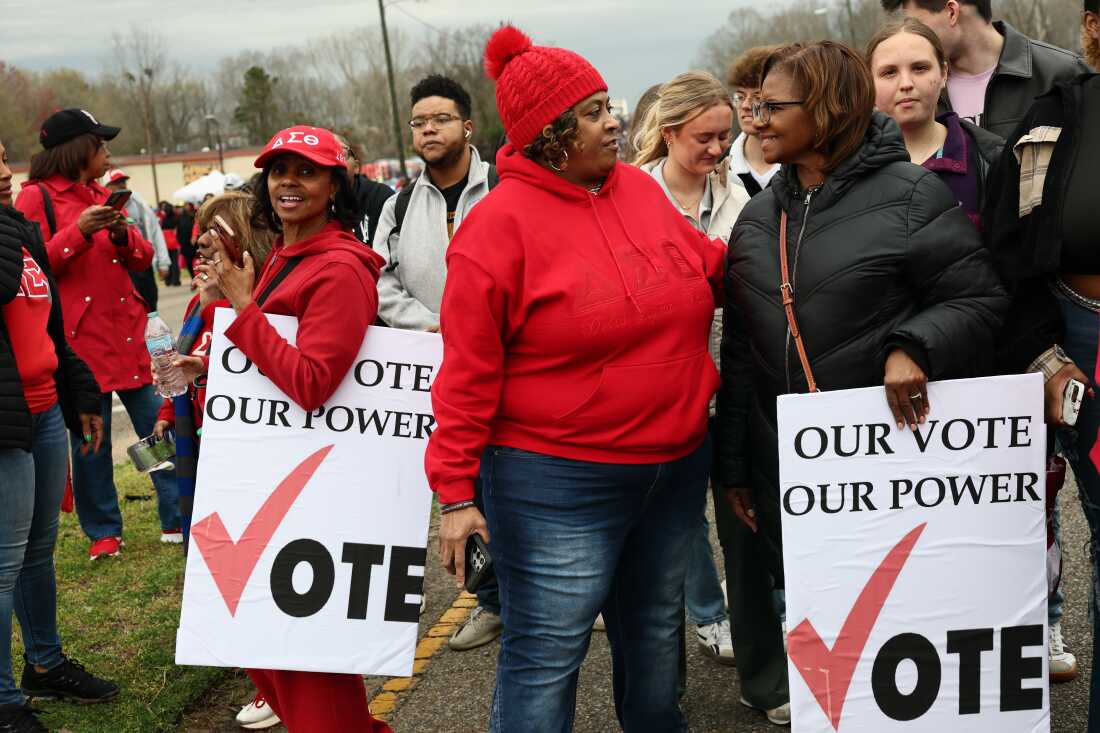
In 2025, members of the Delta Sigma Theta sorority and other marchers gathered in Selma, Ala. to remember the 60th anniversary of the Bloody Sunday march that led to the Voting Rights Act. This event occurred amidst Republican-led states in the South rapidly redrawing congressional maps following the U.S. Supreme Court’s weakening of the Voting Rights Act’s protections against racial discrimination. The decision’s local impact might be significant. An NPR analysis reveals active lawsuits over 17 voting maps or election systems affected by the court’s ruling.
Following the Supreme Court’s decision in Louisiana v. Callais, attorneys are preparing briefs on how to apply the reinterpretation of Section 2 of the Voting Rights Act in redistricting. The court ruled that the focus of Section 2 should be on intentional racial discrimination—a challenging standard to prove in legal proceedings. Experts believe this change may threaten racial minority representation and encourage more partisan gerrymandering at state and local levels, including local government bodies like school districts and county commissions.
In North Carolina, the Supreme Court’s ruling led state Rep. Rodney Pierce, a Democrat, to drop a lawsuit challenging the state’s Senate map. Pierce stated the Voting Rights Act is now “a meaningless law with no teeth” due to the decision, eliminating pathways to protect Black citizens’ voting rights. Similar legal challenges emerge mostly from the South, where voting tends to be polarized between white and Black communities favoring different candidates. However, Latino voters are challenging Washington’s state legislative map, and Native American voters in North Dakota are contesting legislative districts under Section 2.
Challenges for Local Redistricting
Many Section 2 cases have historically dealt with municipal government, where districts are easier to draw for racial minorities. Michael Li, a redistricting expert at the Brennan Center for Justice, notes that Section 2 historically helped break political fiefdoms in the South. Yet, the new legal challenges may enable white majorities to reassert dominance, designing maps that lock in their power.
Li indicates the Supreme Court now encourages opponents of majority-minority districts to argue political reasons for their map designs, even in nonpartisan government bodies, such as school boards. Future local level disputes may reflect various political interests or incumbents’ protection, complicating district arrangements.
Shift Toward At-Large Voting
The Supreme Court ruling complicates Section 2 challenges by demanding separation of race from partisan preference in racially polarized voting regions—problematic due to lack of local partisan data. Gilda Daniels, law professor at the University of Baltimore, highlights this complexity and how the Justice Department, under the Trump administration, shifted focus away from racial minority voting rights enforcement. Daniels warns that some jurisdictions may switch from district-based to at-large systems, which often favor majority populations, wasting minority votes.
Maureen Edobor, law professor at Washington and Lee University, emphasizes how at-large systems can exclude racial minorities. In racially polarized voting areas, majority populations often win all seats, leaving minority voting ineffective.
Future Redistricting Disputes
Elton Holmes, local NAACP branch president in Fayette County, Tenn., prepares for more setbacks. With the Justice Department leaving a Section 2 lawsuit, Holmes’ NAACP and Black voters won a new district map with three out of 10 districts majority Black. Following the Supreme Court decision, the county held its first primary under these new guidelines. Holmes expresses concern about white commissioners reverting to gerrymandering should election results displeased them.
Advocacy groups like Fair Fight Action warn that nearly 200 Democratic-held state legislative seats, particularly in majority-Black districts, risk elimination due to the Supreme Court’s changes. The court’s future rulings could further affect enforcement of remaining Voting Rights Act protections.